The search for life beyond Earth has entered a new, high-stakes era, characterized by rapid technological advancements and increasingly tantalizing, albeit ambiguous, data. In 2025, the scientific community and the public alike were gripped by two major announcements: the detection of potential biosignatures on the exoplanet K2-18b and the discovery of a curious, mineral-rich rock on Mars nicknamed "Cheyava Falls." These events were widely heralded in media outlets as the "strongest hints yet" of biological activity elsewhere in the universe. Yet, behind the sensationalist headlines lies a complex reality: the scientific community is far more nuanced, cautious, and divided than the binary "yes or no" narratives often presented to the public.
A Chronology of Anticipation
The year 2025 served as a landmark period for astrobiology, punctuated by two distinct events that recalibrated expectations for finding extraterrestrial life.
In April 2025, an international team of researchers utilizing high-resolution spectroscopic data reported the presence of dimethyl sulfide (DMS) and potential traces of dimethyl disulfide on K2-18b, a "Hycean" world located approximately 120 light-years from Earth. On our planet, DMS is primarily produced by biological processes, specifically by phytoplankton in marine environments. The report suggested that if these molecules were indeed present in the atmosphere of an exoplanet, they could serve as a potential biosignature. The media reaction was instantaneous, with many outlets framing the data as a definitive step toward identifying a living world.
The second major development occurred in September 2025, when NASA’s Perseverance rover, currently exploring the Jezero Crater on Mars, identified a rock sample at a location dubbed "Cheyava Falls." The rock exhibited intriguing "leopard spots"—small, white, mineral-encircled rings that, on Earth, are frequently associated with microbial metabolic processes. NASA Administrator Sean Duffy described the discovery as the closest humanity has ever come to confirming that Mars once hosted life. This announcement carried significant weight, as it involved physical samples that could be analyzed with more direct instrumentation than distant atmospheric readings.
The C-Scope Survey: Data Versus Perception
To bridge the gap between media portrayal and expert consensus, researchers at Durham University’s Centre for Scientific Community Opinion Polling and Evaluation (C-Scope) conducted a systematic survey of hundreds of astrobiologists globally. The goal was to quantify how the experts themselves interpreted the evidence provided by the K2-18b and Cheyava Falls cases.
The survey results revealed a striking degree of scientific caution. When asked if the data regarding K2-18b likely indicated the discovery of extraterrestrial life, only 6.6% of respondents agreed. A staggering 65.4% expressed disagreement, while 28.0% adopted a neutral stance.
The sentiment shifted slightly when experts were presented with the Mars findings. While still cautious, the level of agreement rose to 15.1%, with 44.6% disagreeing and 40.3% remaining neutral. Most notably, the percentage of astrobiologists who "strongly disagreed" that life had been found dropped from 35.1% in the case of K2-18b to 11.1% for Mars. This data suggests that while the community remains skeptical, the direct, local evidence of the Martian rock fostered a more open-minded, albeit still unconvinced, scientific climate.
Why Context Matters in Scientific Interpretation
The divergence in opinion between the K2-18b findings and the Cheyava Falls sample underscores the fundamental difficulty of astrobiology: distinguishing between biological signatures and "false positives" generated by non-biological, abiotic processes.
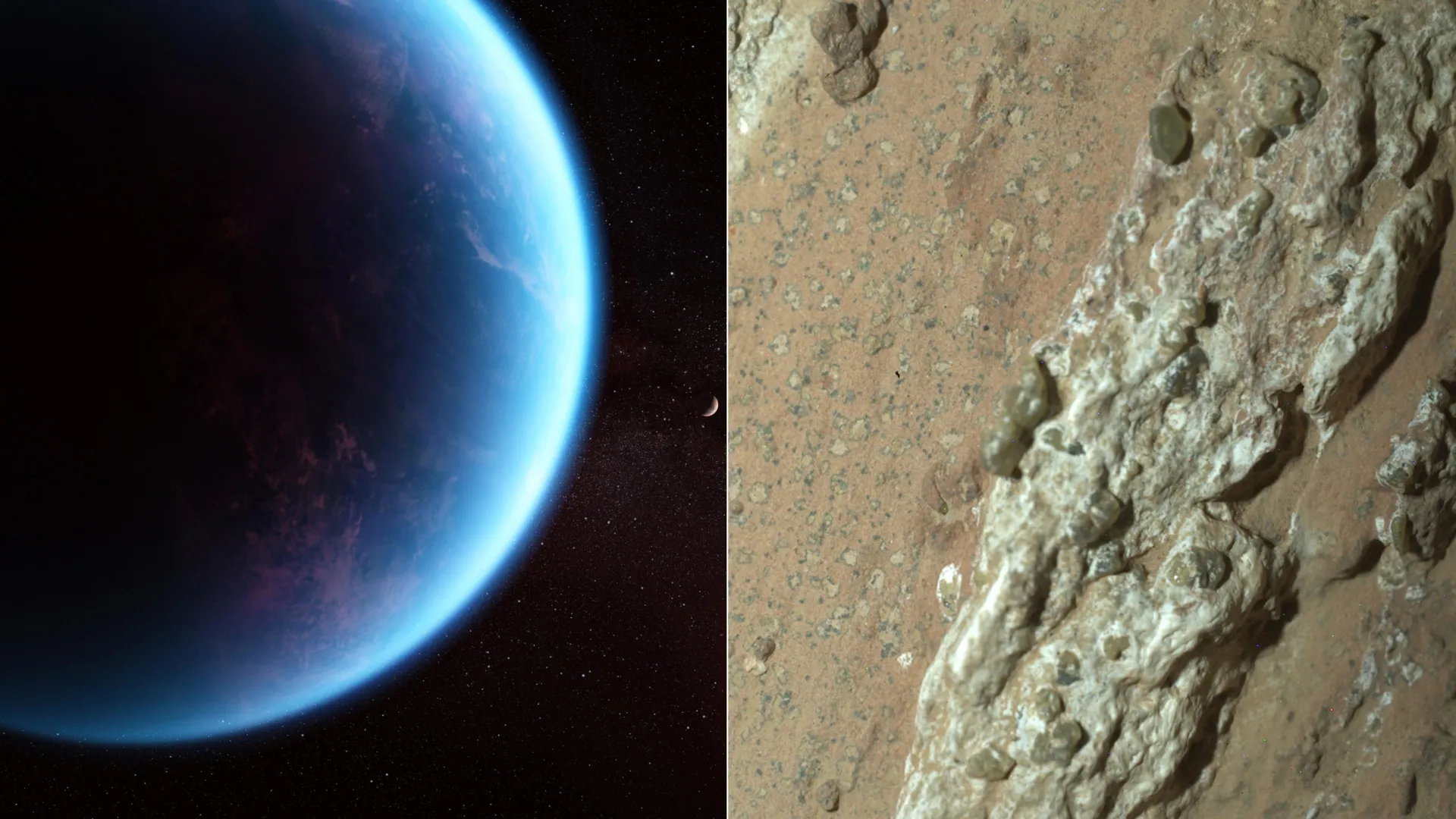
In the case of K2-18b, the challenge lies in the sheer distance. Atmospheric signatures detected through transit spectroscopy are susceptible to noise, instrument error, and misinterpretation of chemical pathways. Conversely, the Mars sample, while physically accessible, presents its own set of interpretive hurdles. Geologists have long documented how mineral rings and "leopard spots" can form through volcanic activity, sediment precipitation, and other geological processes that have nothing to do with biology.
The "neutral" category in the C-Scope survey is particularly revealing. In scientific discourse, a large neutral contingent often signals that the data is genuinely inconclusive or that the hypothesis is currently too speculative to warrant a firm professional commitment. By forcing a binary "for" or "against" label on these complex issues, public discourse often flattens the nuanced spectrum of scientific doubt, which is essential to the integrity of the peer-review process.
The Risk of Consensus-Based Communication
The reliance on phrases such as "the science says" or "scientists believe" creates a false sense of monolithic agreement. When journalists or public officials use these terms, they often inadvertently obscure the reality that scientific knowledge is a process, not a destination.
In fields ranging from climate change to artificial intelligence and pandemic preparedness, the nuance of scientific opinion is often sacrificed for the sake of a clear, compelling story. This is not to suggest that there is no consensus in science; there is overwhelming agreement on many fundamental principles, such as the mechanism of the greenhouse effect or the theory of evolution. However, when it comes to "frontier" science—the edge of the unknown where data is emerging and uncertainty is high—the majority of experts are rarely in absolute lockstep.
The danger of this disconnect is that when a high-profile "breakthrough" is later refined, challenged, or debunked, the public may perceive the change as a failure of science, rather than as the scientific method working as intended. Misrepresenting the state of expert opinion can erode public trust and undermine the credibility of research institutions.
Broader Implications for Future Discoveries
As humanity continues to probe the cosmos, the frequency of "potential" discovery announcements is likely to increase. Upcoming missions, such as the European Space Agency’s Ariel mission or the continued exploration of the Martian surface by international space agencies, will inevitably produce more data points that look like potential biosignatures.
The methodology established by organizations like C-Scope offers a template for how society might better digest these developments. By prioritizing the distribution of expert opinion rather than relying on selective, high-profile quotes, we can foster a more scientifically literate public. This approach does not seek to replace rigorous empirical evidence with popularity contests; rather, it aims to provide a more accurate map of the intellectual landscape surrounding a given claim.
A Call for Transparent Discourse
Ultimately, the quest to determine whether we are alone in the universe is a foundational human endeavor. It is a question that defines our place in the cosmos. However, the scientific community’s strength lies in its skepticism, its propensity for disagreement, and its reliance on replicable, empirical proof.
If public interest and political funding are increasingly tethered to the promise of discovering alien life, the communication surrounding these discoveries must evolve. We must move away from the "all or nothing" framing that characterizes modern news cycles and embrace the complexity of the scientific process. Uncertainty is not a sign of failure; it is the engine of discovery. When we finally confirm the existence of extraterrestrial life—whether it is a simple microbe in a Martian rock or a complex atmospheric signature in a distant galaxy—that discovery will be the result of years of disciplined, cautious, and intensely debated research. By better understanding how scientists think, the public can better appreciate the magnitude of that day when it finally arrives.