Maine Democrats rally around Troy Jackson to replace Graham Platner in crucial Senate race – US politics live

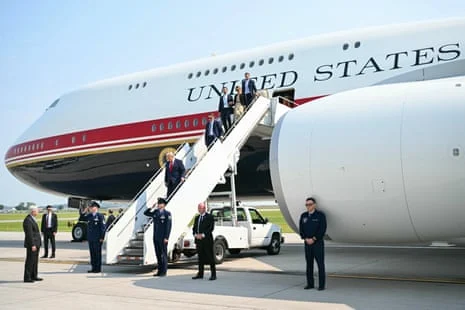
Washington D.C. – In a flurry of significant developments impacting national security, legal precedents, and domestic politics, President Donald Trump announced forthcoming "maxed out" security upgrades for the Boeing luxury jet donated by Qatar, which has been serving as an Air Force One aircraft. This declaration comes amidst mounting concerns regarding the plane’s defensive capabilities and a contentious leak investigation targeting The New York Times. Simultaneously, the Trump administration made an unprecedented move by activating the long-dormant Alien Terrorist Removal Court (ATRC) with its first-ever petition to deport an individual deemed an "alien terrorist." On the political front, Maine Democrats coalesced around former state legislator Troy Jackson, positioning him as the likely nominee to challenge Republican Senator Susan Collins in a critical Senate race, following the withdrawal of the initial candidate embroiled in scandal. These events unfold against a backdrop of escalating tensions in the Middle East, which have directly contributed to a sharp increase in national gasoline prices.
Presidential Aircraft Under Scrutiny: The Qatari Gift and National Security Implications
President Donald Trump revealed on Sunday that the Boeing luxury jet, gifted by the Qatari government and currently serving as a presidential transport, is slated for significant security enhancements. Speaking to reporters upon his return from the World Cup final in New Jersey, the President indicated the aircraft would be sent for "maxed out" upgrades within approximately a month. "Well, it has – it has a lot, and you know it has a lot of capability, but as I understand it, in about a month or so, they’re going to send it to have it be maxed out," Trump stated, adding, "It’ll take about a month," suggesting the imminent addition of advanced defensive capabilities.
The $400 million luxury jet was accepted by the Trump administration last year as an "unconditional" gift from Qatar, a move that sparked considerable debate regarding the ethical and security implications of accepting such a substantial donation from a foreign government. The President began utilizing the aircraft on July 1, 2026, for official travel. However, questions about its security features escalated earlier this month after a peculiar itinerary change: President Trump unexpectedly switched from the new Qatari-gifted aircraft to an older Air Force One model for a leg of his journey from Turkey to England, following his participation in the NATO summit in Ankara. This unannounced change raised eyebrows among defense analysts and the press, fueling speculation that the newer plane might lack critical defensive countermeasures inherent in the primary presidential fleet.
Indeed, these suspicions were corroborated by a New York Times report published earlier in July. Citing anonymous sources, the report alleged that the Qatari-donated jet lacked the sophisticated defensive countermeasures, including anti-missile capabilities, present in the standard VC-25A aircraft designated as Air Force One. The VC-25A, a highly modified military version of the Boeing 747-200B, is renowned for its extensive array of security systems, which include electronic countermeasures designed to jam enemy radar, flares to deflect heat-seeking missiles, and advanced shielding against electromagnetic pulse (EMP) attacks. It also functions as a mobile command center, equipped with secure communications and an operating room. The idea that a presidential transport might operate without these critical protections immediately triggered national security alarms.
The New York Times’ investigative reporting on the aircraft’s vulnerabilities provoked a swift and aggressive response from the Trump administration. A leak investigation was initiated, and the Justice Department issued subpoenas to several New York Times journalists, some of whom received them at their homes. This action was widely condemned by media organizations, press freedom advocates, and legal experts as an overt attempt to punish the newspaper for its reporting and to intimidate independent media. Critics argued that such measures undermined the fundamental principles of a free press, which serves as a crucial check on government power. The New York Times has since filed a motion to quash these subpoenas, asserting its First Amendment rights and challenging the administration’s perceived overreach. The legal battle highlights the ongoing tensions between the executive branch and the press, particularly on matters of national security and classified information.
The decision to acquire and then upgrade a foreign-donated aircraft for presidential use has broader implications. While diplomatic gifts are common, the sheer value and strategic importance of a presidential transport aircraft make this donation unusual. The episode raises questions about procurement processes for high-value national assets, potential conflicts of interest, and the transparency surrounding such arrangements. Furthermore, the necessity of these "maxed out" upgrades implicitly confirms the initial security deficiencies reported by the media, retroactively validating the concerns raised by The New York Times and defense experts. The cost and timeline of these upgrades, though unspecified by the President, will undoubtedly add to the overall expenditure associated with the aircraft, a detail that was perhaps obscured by the initial framing of the plane as an "unconditional gift."

Activation of the Alien Terrorist Removal Court: A Dormant Power Awakens
In a move described as unprecedented, the Trump administration’s Justice Department has filed the first-ever petition to the Alien Terrorist Removal Court (ATRC), a secretive judicial body established 30 years ago but never before utilized. The ATRC was created as part of the 1996 Antiterrorism and Effective Death Penalty Act (AEDPA), enacted in the wake of the Oklahoma City bombing and designed to enhance the government’s ability to combat terrorism, particularly by non-citizens. Its purpose is to consider government requests for the deportation of non-citizens designated as "alien terrorists" based on classified evidence that might not be admissible in conventional immigration or criminal courts.
Despite its establishment three decades ago, the ATRC has remained dormant until Wednesday, July 16, 2026. Legal scholars and civil liberties advocates have long pointed to the court’s unique structure and the potential for due process concerns as reasons for its disuse. The court is composed of five federal district judges, designated by the Chief Justice of the Supreme Court, and operates under specific, often classified, rules of procedure. The high evidentiary bar required by AEDPA, which demands "clear and convincing evidence" that an individual is an alien terrorist and poses a threat, combined with the constitutional complexities surrounding the use of secret evidence against a respondent, led successive administrations to favor other legal avenues, such as traditional immigration proceedings or criminal prosecutions, for dealing with suspected foreign terrorists.
The Justice Department’s petition, the details of which remain largely undisclosed, seeks the removal of an individual whose name has been withheld from the public document posted on the court’s website. Following the filing, a hearing was promptly held on Thursday, July 17, 2026, presided over by Chief Judge Joan Ericksen, a federal judge from Minnesota. In a written response to the petition, Judge Ericksen indicated that the court had "questions about the nexus that the government alleges between the actions of the respondent and the specific sections and subsections it invokes with respect to those actions." She further elaborated, stating, "The answers persuaded the court that the government could benefit from the opportunity for more thoughtful consideration." Consequently, Judge Ericksen directed the Justice Department to provide more information by Wednesday, July 23, 2026.
This activation of the ATRC marks a significant shift in the administration’s approach to counter-terrorism and immigration enforcement. Civil liberties organizations, such as the American Civil Liberties Union (ACLU), are expected to voice strong objections, highlighting concerns about due process, the right to confront accusers, and the potential for individuals to be deported based on classified information they cannot challenge. Legal experts suggest that the court’s proceedings, shrouded in secrecy and potentially involving evidence withheld from the respondent and their counsel, could set a troubling precedent for the rights of non-citizens in the U.S. The "nexus" question raised by Judge Ericksen suggests the court is rigorously scrutinizing the government’s application, indicating an awareness of the profound legal implications of this historic activation. The outcome of this initial petition will be closely watched, as it could dictate the future use and perceived legitimacy of this extraordinary judicial body.
Maine’s Pivotal Senate Race: Troy Jackson Rises from the Ashes of Scandal
In a dramatic turn of events, Maine Democrats have rallied swiftly and decisively behind former state legislator Troy Jackson, positioning him as the clear frontrunner to become their nominee in the crucial Senate race against long-serving Republican incumbent Senator Susan Collins. This rapid consolidation follows the earlier withdrawal of the party’s initial nominee, Graham Platner, whose campaign imploded amidst a series of scandals, including a sexual assault allegation that he denies.
The Democratic Party, acutely aware of the national significance of the Maine seat, understood the imperative of quickly unifying behind a viable candidate. Maine is widely considered a "must-win" state in the Democrats’ broader mission to gain control of the U.S. Senate in the upcoming November midterm elections. The current Senate is narrowly divided, and every seat, particularly those held by long-term incumbents like Collins, is fiercely contested.
Over the past weekend, a wave of high-profile Democratic figures withdrew their candidacies and threw their support behind Jackson. Maine’s Secretary of State, Shenna Bellows, announced her withdrawal yesterday morning, emphasizing the need for party unity. "Democrats don’t have a day to waste in unifying around the goal of defeating [Senator] Susan Collins," Bellows stated, underscoring the urgency of the situation. Later in the evening, Nirav Shah, the former director of Maine’s Centers for Disease Control and Prevention and a respected public health figure, also dropped out and endorsed Jackson. They were soon followed by Dan Kleban, co-founder of the popular Maine Beer Company, and Jordan Wood, a progressive political operative who previously served as chief of staff to former California Representative Katie Porter. Both Kleban and Wood also publicly endorsed Jackson.

Troy Jackson, 58, hails from northern Maine and boasts a distinct working-class background as a fifth-generation logger. His political career includes serving in the state legislature, where he eventually rose to become the president of the Maine Senate. He left office in 2024 due to term limits. While he unsuccessfully sought the Democratic nomination for governor earlier this year, an endeavor in which he had Platner’s backing, his deep roots in the state and populist appeal are seen as strengths in a general election.
The surge of support for Jackson was evident at county-level party meetings held over the weekend, where committees across Maine began selecting delegates for a statewide nominating convention scheduled for July 25 in Bangor. Although not legally binding, according to a report by POLITICO, over two-thirds of the 601 delegates have already committed to voting for Jackson at the convention. This overwhelming delegate support effectively ensures his nomination, providing the Democratic Party with a clear path forward just months before the critical November elections. The party hopes that Jackson’s authentic Mainer image and strong progressive credentials will resonate with voters eager for a change, presenting a formidable challenge to Senator Collins, who has skillfully navigated Maine’s independent-minded electorate for decades.
Economic Fallout: Rising Gasoline Prices Amid Geopolitical Tensions
The complex interplay of global geopolitics and domestic policy was underscored by a significant economic impact: the national average price for a gallon of regular gasoline jumped once again on Monday, directly linked to the escalating "US-Israel war on Iran" (as phrased in the accompanying live blog link, though the immediate context specifies "US and Iran launched more attacks"). According to the motor club federation AAA, the national average now stands at $4 per gallon, a substantial increase from the $3.14 per gallon recorded just a year ago.
This recent surge marks a return to price levels seen at the onset of the conflict in the Middle East, which began in late March. Gasoline prices had experienced a brief respite in mid-June, continuing to fall after what was described as an interim deal between the U.S. and Iran. However, renewed hostilities and the intensified military actions between the United States and Iran have disrupted global oil markets, leading to increased volatility and a sharp upward trajectory in crude oil prices. The Strait of Hormuz, a critical chokepoint for global oil shipments, is particularly sensitive to regional instability, and threats to its passage directly impact supply and pricing.
The persistent rise in fuel costs is a direct consequence of heightened geopolitical risk in the Middle East, a region central to global oil production and distribution. Analysts suggest that investors are pricing in a greater risk premium for crude oil, anticipating potential supply disruptions as the conflict intensifies. For American consumers, this means higher costs at the pump, impacting household budgets, transportation expenses, and potentially contributing to broader inflationary pressures across the economy. The economic ripple effects of sustained high energy prices could be far-reaching, influencing consumer spending, business logistics, and overall economic growth as the country heads into the crucial midterm election season.
Related posts: