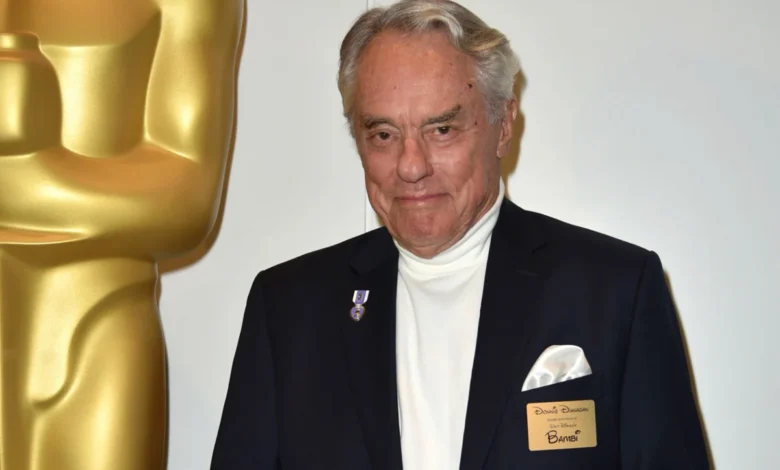
The world of cinema and military history lost a singular figure this month with the passing of Donnie Dunagan. A man who occupied two vastly different worlds—the enchanting, ink-and-paint realm of Golden Age Hollywood and the harsh, high-stakes reality of the United States Marine Corps—Dunagan died on November 4 due to complications from lung cancer. He was 92 years old. His representatives at CelebWorx, Kris Jones and Nery Lemus, confirmed the passing, noting that Dunagan faced his final days with the same discipline and grace that defined his remarkable, bifurcated life.
A Rapid Rise in Hollywood
Born on August 16, 1934, in San Antonio, Texas, Dunagan’s path to the silver screen was as unlikely as it was swift. His childhood was defined by mobility; his family moved frequently before settling in Memphis, Tennessee. It was there that his natural charisma caught the eye of a local dance instructor, leading to a series of talent show victories. These early successes were not merely local curiosities; they acted as a siren call to Hollywood scouts. By the age of four, Dunagan had moved to California and secured a contract with RKO Pictures, marking the beginning of a brief but potent acting career that would span only a few years but leave an indelible mark on American culture.
His filmography, though limited to seven projects, includes credits that would define the era. In 1938, he made his screen debut in the family drama Mother Carey’s Chickens. By 1939, he had landed a significant role in the horror classic Son of Frankenstein, portraying Peter, the son of the titular scientist. This role placed him on set with icons of the genre, including Boris Karloff, Bela Lugosi, and Basil Rathbone.
However, his most enduring legacy was solidified in 1942. Walt Disney personally identified Dunagan for the role of Bambi, specifically citing his expressive brown eyes as the perfect template for the young fawn. The process was grueling for a child actor, involving hours of sitting before Disney’s animators, who would request a wide spectrum of emotions—from joy to melancholy—to capture the nuance of the deer’s movements. Dunagan later described this as the highlight of his youth, a foundational experience that he kept close to his heart for decades.
The Great Secret: From Bambi to the Battlefield
The transition from child star to a soldier was abrupt. Following his parents’ divorce, Dunagan’s life took a more challenging turn, involving time in orphanages and boarding schools. Through sheer resilience, he maintained his education and athletic pursuits, eventually earning a football scholarship to the University of Alabama. In the early 1950s, he made a career-defining choice: he volunteered for the United States Marine Corps.
For 21 years, Dunagan served his country, rising to the rank of Major. His military service was extensive, encompassing two tours in Vietnam and service during the Korean War. He was decorated with a Bronze Star and a Purple Heart, symbols of a life lived in service to duty. Yet, throughout this period, he maintained a profound silence regarding his cinematic past.
In a 2005 interview with the Houston Chronicle, Dunagan explained the psychological and professional weight of this duality. "I was blessed to be in a leadership role for 25 years, either in counterintelligence or training troops," he stated. "And if these animals I was leading had ever found out about Bambi… they’d have ridden me out on a rail." The perceived incongruity between the gentle, innocent voice of a fawn and the hardened reality of a Marine Corps officer was a gap he felt he could not bridge while in uniform. He prioritized the respect of his fellow Marines, fearing that the "Bambi" label would undermine his authority and the lethal seriousness of his mission.
A Legacy Reclaimed
Following his retirement from the military, Dunagan stepped away from the public eye entirely, living a quiet life removed from the glitz of his childhood. It was not until the early 2000s, when Disney reached out to him for a special DVD edition of Bambi, that the secret was finally unveiled.
The revelation was met not with the ridicule he had once feared, but with overwhelming affection from the public. He transitioned into the role of a Disney ambassador, attending conventions and connecting with fans who were fascinated by the intersection of his two lives. This final chapter of his life allowed him to embrace his history, reconciling the young boy who voiced a forest prince with the veteran who commanded troops in the jungle.
Historical and Cultural Context
The arc of Dunagan’s life offers a unique case study in 20th-century American history. He represented the "Greatest Generation" archetype—children who matured during the Great Depression and were then thrust into the machinery of global warfare. His story is particularly poignant when viewed through the lens of early animation history. In the late 1930s and early 1940s, Disney’s Bambi was a groundbreaking technological achievement, pushing the boundaries of realism in cel animation. Dunagan was an essential, albeit hidden, piece of that technical puzzle.
From a broader perspective, his life underscores the transient nature of fame during that era. Unlike today’s child actors, whose lives are often documented from birth, Dunagan was able to successfully "erase" his past, reinventing himself as a career officer. The psychological discipline required to compartmentalize these two lives is a testament to his character.
Official Responses and Public Sentiment
The reaction from his representatives serves as a final, moving tribute to his character. "While he asked us not to be sad due to the great life I lived, it would be amiss not to share the impact that Donnie had on people when they met him," said Kris Jones and Nery Lemus. They highlighted his "infectious smile," "warmth," and a "child-like spirit" that endured long after his time on the screen.
Fellow veterans and fans have since taken to social media and veteran forums to share their condolences, noting that his life serves as a bridge between the innocence of childhood imagination and the grim reality of military sacrifice. His story has resonated with a generation that values the quiet dignity of a hero who didn’t seek the spotlight but was nonetheless defined by his service to both country and culture.
Implications and Reflection
Donnie Dunagan’s death marks the conclusion of a life that defies traditional categorization. As an actor, he contributed to a film that remains a cornerstone of animation; as a Marine, he spent over two decades protecting the freedoms that allowed such films to be made.
His life also speaks to the concept of "the man behind the mask." For 21 years, he was a silent guardian, a man whose public identity was built on tactical proficiency and leadership, while his private identity was tethered to a childhood dream. The fact that he was eventually able to celebrate both sides of his life speaks to a broader cultural shift—a move toward valuing the complexity of the individual.
Dunagan’s passing serves as a reminder of the fragility of those who carry our collective cultural memories. As the last major contributors to the early Disney era fade, their personal stories become as important as the films themselves. Dunagan leaves behind a legacy that is not merely that of a voice actor or a soldier, but that of a man who navigated the shifting tides of the 20th century with a quiet, persistent integrity. He remained, until his final days, a man who understood the value of a "neverending love story," whether told through the brushstrokes of an animator or the discipline of a soldier.
Related posts: