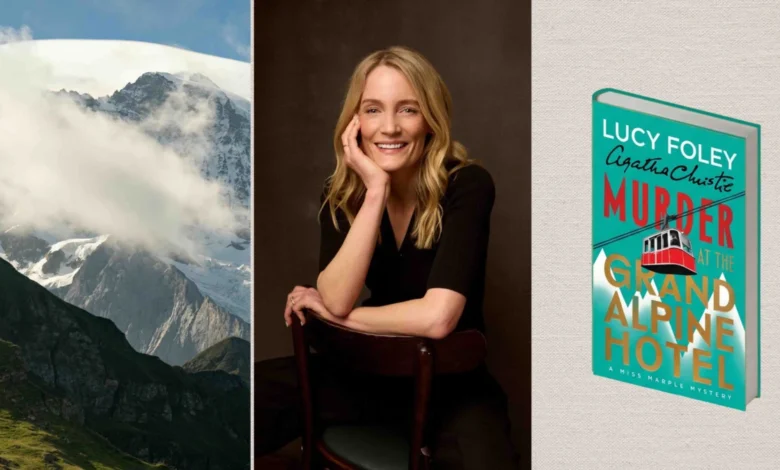
For decades, the cultural geography of Agatha Christie’s literary universe has neatly divided its most famous sleuths by their affinity for travel. While Hercule Poirot traversed the globe on luxury locomotives like the Orient Express, steamships on the Nile, and winding waterways to Venetian palazzos, Jane Marple remained firmly anchored in the quiet, domestic English countryside. Operating out of the fictional village of St. Mary Mead, the unassuming spinster solved dozens of murders largely from her own backyard, viewing human nature through the microcosm of her local parish. However, fifty years after the publication of Christie’s final official Miss Marple novel, the iconic detective is stepping far outside her comfort zone. In a new authorized thriller titled Murder at the Grand Alpine Hotel, bestselling author Lucy Foley has been tapped by the Agatha Christie estate to transport the Victorian sleuth to the treacherous heights of the Swiss Alps.
The literary venture marks a historic milestone for the character, who last appeared in an original novel in the 1976 publication of Sleeping Murder. By pairing Marple with a high-altitude, mid-century espionage aesthetic, Foley’s novel blends the cozy village-mystery tradition with the rugged, masculine action thrillers popularized by authors like Ian Fleming and Eric Ambler during the 1950s. The result is a transatlantic publishing event that reimagines how classic detective fiction interacts with geopolitical history, postwar tension, and the psychological weight of isolation.
Breaking the Mold: Transporting St. Mary Mead to the Swiss Mountains
When the Agatha Christie estate approached Lucy Foley—known for contemporary thrillers like The Guest List—with the proposition of writing a new installment in the Marple canon, the author faced a pivotal creative choice. She could either replicate the comforting familiarity of St. Mary Mead or thrust the elderly detective into an entirely foreign environment. Opting for the latter, Foley decided to send Miss Marple on a rare holiday, mirroring the singular excursion abroad recorded in Christie’s original works, A Caribbean Mystery.
The geographical pivot was designed not merely for aesthetic novelty, but to place Marple in direct conversation with the rugged terrain typically reserved for Cold War spy thrillers and mountaineering adventures. In Foley’s narrative, Marple and her devoted confidante, Dolly Bantry, find themselves staying at the luxurious Grand Alpine Hotel, nestled high above Chamonix. Surrounded by hidden speakeasies, ice-skating waiters in black tie balancing champagne towers, and unforgiving vertical drops, the detectives are forced to navigate a setting vastly different from an English garden party.
According to Foley, the juxtaposition of elderly British women at the nexus of a high-stakes mountain thriller upends traditional power dynamics. The setting allows the narrative to exploit the inherent claustrophobia of a luxury alpine chalet where guests are trapped together by impassable weather, creating a classic locked-room scenario on a grand, mountainous scale.
Historical Context: Postwar Europe and the Porous Alpine Borders
Set in the early 1950s, Murder at the Grand Alpine Hotel utilizes its unique geographical backdrop to reflect the fragile sociopolitical landscape of post-World War II Europe. The novel’s opening scenes establish a tense tableau aboard a train ascending the mountain, where citizens from France, Italy, Great Britain, the United States, and Germany are suddenly thrown into close proximity.
This forced integration occurred against a backdrop of ongoing economic hardship. While mainland European nations struggled to recover from the devastation of the conflict, Great Britain maintained strict rationing protocols well into the 1950s, leaving its citizens visibly bearing the physical tolls of austerity. Foley leverages these stark national contrasts—noted on the page through subtle cultural markers like the quality of luggage, furs, and general physical vitality—to highlight lingering postwar resentments.
Furthermore, the choice of the Swiss-French-Italian borderlands carries deep historical resonance. During World War II, these rugged mountain passes served as porous transit points, difficult for national governments to monitor or defend. In Foley’s narrative, this history is not just background texture; it actively informs the complex backstories of the hotel’s guests. Several characters have returned to the region under suspicious circumstances, carrying wartime secrets and having quietly rewritten their own histories to suit their postwar ambitions. This blending of cozy domestic deduction with the lingering shadows of fascism and espionage elevates the stakes of the mystery far beyond the typical village vendetta.
Researching the Alps: From the Romantic Reimagining to Modern Hazards
To achieve historical and atmospheric authenticity, Foley undertook an extensive research itinerary across the European Alps, driving from Chamonix in the French Alps to Zermatt, St. Moritz, and various Italian resorts through the Mont Blanc tunnel. This physical immersion was crucial for capturing the distinct psychological duality of mountain landscapes—a dichotomy deeply rooted in European cultural history.
Foley notes that human perception of the Alps underwent a radical transformation during the Romantic era. Prior to the 18th century, mountains were widely viewed with dread, associated with danger, untamed wilderness, and mythical perils. It was the Romantics who successfully reframed the peaks as spaces of sublime beauty and spiritual wonder. Modern visitors, however, continue to navigate a middle ground between breathtaking alpine hospitality and existential risk.
Foley’s personal mountaineering experiences directly informed the perils faced by characters in the novel. Journeys such as skiing the Vallée Blanche—a legendary route descending the Mer de Glace glacier near Chamonix—exposed her to the stark realities of high-altitude navigation: navigating steep vertical drops in crampons, walking roped-along ridges, and remaining acutely aware of hidden crevasses.
Historical research similarly yielded colorful period details that were integrated into the narrative. Visits to legendary alpine institutions such as Badrutt’s Palace Hotel and the Kulm Hotel in St. Moritz uncovered archival photographs of ice-skating waiters from the mid-20th century. These professionals would routinely glide across outdoor rinks in full black-tie attire, executing complex tricks while balancing trays laden with champagne buckets and glassware. Such vivid historical curiosities provide the Grand Alpine Hotel with a rich, immersive texture that anchors the fictional narrative in real-world luxury hospitality traditions.
The Architecture of Suspense: Why Hotels Remain Prime Locales for Whodunits
The choice of a grand hotel as the central locus for a murder mystery is a time-tested literary device, one successfully utilized by Agatha Christie herself in works such as At Bertram’s Hotel. Hotels function as unique sociological laboratories, operating under a specific set of architectural and psychological rules.
From a structural standpoint, a grand hotel offers a defined geography featuring both public spaces and hidden corridors, service stairwells, and private staff quarters accessible only to seasoned guests or observant employees. Foley capitalized on these spatial layers by incorporating architectural elements like secret bars—inspired by actual historical features found in properties like the Kulm Hotel—into the Grand Alpine setting.
Psychologically, hotels provide an environment of anonymity. Guests can check in and adopt personas distinct from their everyday lives, transforming the luxury resort into a democratizing yet deceptive space. This anonymity is precisely what makes the setting fertile ground for deception, as individuals can easily mask their true identities, motives, and past histories behind a veneer of wealthy leisure.
Miss Marple as the Ultimate Global Observer
Despite her reputation as a homebody, Miss Marple’s enduring appeal as a traveler lies in her fundamental methodology: acute observation and a profound, unflinching understanding of human nature. Unlike Hercule Poirot, whose sharp intellect can occasionally be swayed by superficial charm or youth, Marple evaluates humanity through a lens honed by her observations in St. Mary Mead—which she regards as a micro-representation of the broader world.
Whether operating in an English village, traveling to the Caribbean in A Caribbean Mystery, or navigating a snowbound Swiss chalet, Marple applies her lived experience universally. She recognizes that greed, malice, and ambition transcend geographic borders. Furthermore, Marple’s character possesses a subtle emotional depth; rather than acting solely out of intellectual curiosity, she is occasionally driven by righteous anger or a deep sense of moral duty, transforming into a formidable force of retribution, akin to the mythological figure of Nemesis.
Broader Implications and Future Prospects
The publication of Murder at the Grand Alpine Hotel represents a significant shift in how literary estates manage classic intellectual property. By inviting acclaimed contemporary authors to pen authorized continuations of legendary series, publishers can bridge generational gaps, introducing canonical characters to modern audiences while honoring the foundational rules established by the original creators.
While Foley has characterized her foray into the Marple canon as a singular project, the novel successfully demonstrates that classic detective formulas can be successfully adapted to new genres, geographies, and historical eras without losing their core identity. Whether Miss Marple will be dispatched to other international destinations based on subtle biographical hints found in Christie’s texts remains to be seen. However, by conquering the Swiss Alps, Jane Marple has firmly proven that world-class detection requires nothing more than a sharp eye, a steady constitution, and an unyielding commitment to the truth—no matter how high the altitude.
Related posts: