Ancient Chinese Eclipse Records Provide New Insights into Earth’s Rotation and Solar Activity Across Three Millennia

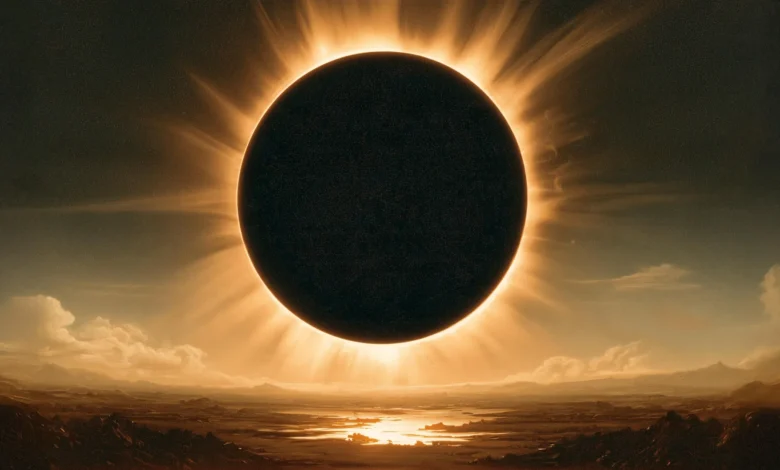
An international research team has revisited one of the oldest precisely dated records of a total solar eclipse, uncovering new details about how Earth’s rotation has changed over thousands of years. By combining historical geography with modern astronomical calculations, the scientists reconstructed an eclipse that occurred in 709 BCE and determined how it would have appeared from Qufu, the ancient capital of China’s Lu Duchy. The study, published in the Astrophysical Journal Letters, serves as a bridge between the meticulous observations of ancient court astronomers and the rigorous demands of modern planetary science.
The research not only refines our understanding of Earth’s decelerating rotation but also provides a potential glimpse into the Sun’s magnetic state during the eighth century BCE. By recalibrating the geographic coordinates of the ancient Lu capital, researchers have successfully synchronized historical textual accounts with high-precision astronomical simulations, proving that ancient records—when paired with modern analytical tools—remain an indispensable resource for climate and geophysical research.
A Chronology of the 709 BCE Eclipse
The event took place on July 17, 709 BCE, during the early Spring and Autumn period of Chinese history. At the time, the Lu Duchy was a significant political and cultural entity. Court astronomers, tasked with interpreting celestial movements as omens of the emperor’s mandate, recorded the event with striking simplicity: "the Sun was totally eclipsed."
This record was later preserved in the Spring and Autumn Annals, a foundational historical chronicle compiled between the 5th and 3rd centuries BCE. However, the mystery deepened seven centuries later with the publication of the Hanshu (Book of Han), which included an addendum describing the Sun as "completely yellow above and below." Modern experts hypothesize that this description refers to the solar corona—the shimmering, faint outer atmosphere of the Sun that only becomes visible to the naked eye during the brief window of totality.
Reconciling Historical Geography with Modern Astronomy
Initially, the research team encountered a significant hurdle: when they applied modern astronomical models to the 709 BCE eclipse, the predicted path of totality did not pass over the presumed location of the ancient Lu capital, Qufu. In traditional history, the coordinates of ancient cities are often subject to approximation due to the shifting nature of river courses, land development, and urban expansion over three millennia.
The researchers, led by Assistant Professor Hisashi Hayakawa of Nagoya University, conducted a deep dive into archaeological excavation reports and historical maps. They discovered that earlier models had misplaced the site of ancient Qufu by approximately eight kilometers. Once the coordinate error was rectified, the mathematical model aligned perfectly with the historical record. This correction was the pivot point for the study, allowing the team to accurately calculate the Earth’s rotation speed for that era.
Earth’s Rotational Deceleration and Delta T
Earth’s rotation is not a constant; it is subject to subtle, long-term fluctuations. The primary driver of this phenomenon is tidal friction caused by the Moon’s gravitational pull, which acts as a brake on the Earth’s spin. Consequently, the length of a day has been slowly increasing over geologic time.
To quantify this, scientists use "Delta T" (ΔT), the difference between Terrestrial Time (a uniform time scale based on atomic clocks) and Universal Time (based on the actual, variable rotation of the Earth). By pinpointing the exact moment and location of the 709 BCE eclipse, the team was able to constrain the value of ΔT for the 8th to 6th centuries BCE. Their results, placing ΔT between 20,264 and 21,204 seconds, provide a vital data point that bridges the gap in the historical record of Earth’s rotational history. This data is critical for refining the models used to predict the visibility of other ancient celestial events, effectively creating a more precise timeline of the ancient world.
The Solar Corona and the Neo-Assyrian Minimum
Perhaps the most provocative aspect of the study is the investigation into the solar corona. If the Hanshu description is indeed a record of the corona, it represents one of the oldest written observations of this phenomenon in human history.
The description of a "yellow" appearance and the specific shape implied by the text suggest a period of high solar magnetic activity. This is of particular interest to space physicists because the eclipse occurred shortly after the "Neo-Assyrian Grand Minimum" (808–717 BCE), a period of unusually low solar activity characterized by a lack of sunspots. By comparing this historical observation with data derived from radiocarbon levels in tree rings, the researchers were able to infer that the Sun had begun to transition back into a more active phase, likely near the peak of its 11-year cycle.
Radiocarbon dating serves as an independent proxy for solar activity. During periods of low solar activity, the Sun’s magnetic shield is weakened, allowing more cosmic rays to reach the Earth’s atmosphere, which in turn increases the production of carbon-14. By aligning the historical account of the eclipse with the tree-ring data, the team found a compelling correlation, offering a "spot check" that validates solar activity models for that specific window in time.
The Role of Omenology in Preserving Astronomical Data
The precision of these ancient records is no accident. In ancient China, "omenology" was a sophisticated political and scientific practice. Because the emperor was considered the "Son of Heaven," any celestial irregularity—such as a solar eclipse, a comet, or an aurora—was interpreted as a direct communication from the cosmos regarding the legitimacy or conduct of the state.
Consequently, dynasties employed dedicated astronomers who maintained rigorous, continuous records of the heavens. These archives were not merely for scientific curiosity; they were essential instruments of governance. The fact that these records were carefully copied and preserved over centuries, even through dynastic collapses and major cultural shifts, highlights the unique value of the Chinese astronomical tradition for modern researchers.
Official Reactions and Scientific Implications
The collaboration, involving experts from Nagoya University, the National Astronomical Observatory of Japan, and the University of Reading, highlights a growing trend in interdisciplinary science. By integrating solar physics, historical documentation, and geographic analysis, the team has turned an ancient record into a contemporary analytical tool.
"Some of our ancestors were very skilled observers," says Dr. Meng Jin of the Lockheed Martin Solar and Astrophysics Laboratory. "When we combine their careful records with modern computational methods and historical evidence, we can potentially find new information about our planet and our star from thousands of years ago."
The implications of this research are twofold. First, it offers a more nuanced understanding of the Earth-Moon system and the long-term dynamics of our planet’s rotation. Second, it validates the use of historical texts as reliable scientific data, provided that the geographic and chronological contexts are rigorously audited.
Broader Impact on Space Weather Forecasting
While a study of an event 2,700 years ago might seem detached from modern concerns, it has significant implications for our understanding of "space weather." The Sun’s long-term cycles, including its tendency to enter "grand minima," remain difficult to predict. By reconstructing solar behavior over millennia, scientists can better calibrate their models for the future. Understanding how the Sun behaved as it emerged from a grand minimum in 709 BCE helps researchers grasp the patterns and triggers of solar variability, which is essential for protecting modern satellite infrastructure, power grids, and communication networks from intense geomagnetic storms.
In conclusion, the 709 BCE eclipse stands as a testament to the enduring value of scientific observation. What began as a court record intended for an ancient emperor has become a vital data point for 21st-century geophysics. By correcting a mere eight-kilometer discrepancy in the location of the ancient Lu capital, the researchers have managed to synchronize the past with the present, proving that the light of a long-faded sun still holds the power to illuminate the complexities of our world today.