Sao Paulo GP: Can Max Verstappen, Lewis Hamilton come from the back again as Lando Norris hopes for rain to fight Kimi Antonelli

For the third consecutive year, McLaren’s Lando Norris has secured pole position at the Brazilian circuit, a testament to his single-lap prowess at this demanding venue. However, the optics of the grid are unconventional. Sharing the front row is the newly crowned 2025 Formula 1 World Champion, Kimi Antonelli, whose meteoric rise with Mercedes has culminated in a dominant rookie season. Behind them, the field is peppered with rising stars and grid-penalized titans, creating a high-stakes environment where the championship hierarchy is effectively neutralized at the start.
A Grid Turned Upside Down
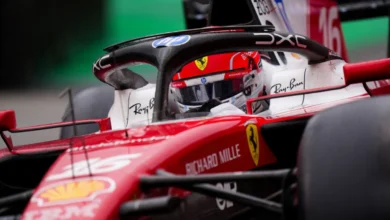
The traditional order of Formula 1 has been turned on its head following a series of strategic power unit changes and technical penalties. Red Bull’s Max Verstappen, the perennial favorite, finds himself relegated to the back of the grid after an engine change, a stark contrast to his heroic victory from 17th on the grid at this same venue in 2024. Joining him at the rear is Lewis Hamilton, whose Ferrari campaign has hit a significant hurdle this weekend, leaving the seven-time champion with a monumental task to recover ground.
Charles Leclerc, also representing Ferrari, will start 14th after a 10-place grid penalty for internal combustion engine changes. Meanwhile, Mercedes’ George Russell, who qualified strongly but fell victim to a costly team strategic error and a subsequent five-place engine penalty, starts from seventh. This exodus of front-runners from the top ten has cleared the path for the likes of Liam Lawson, Nico Hulkenberg, Isack Hadjar, and Oliver Bearman to occupy positions they would rarely contest in a standard qualifying session.
Mercedes team principal Toto Wolff characterized the situation as a "reverse grid race" in all but name. Speaking to Sky Sports F1, Wolff maintained a pragmatic outlook, noting, "It is exciting. We want to lock in the points for the Constructors’ Championship, but in terms of the spectacle, it’s all floodgates open. Let’s race."
The Strategic Landscape of Interlagos
The Autódromo José Carlos Pace is unique in the modern F1 calendar. With its undulating surface, high-altitude cooling challenges, and a layout that forces constant acceleration, it is a driver’s track. However, the introduction of "Overtake Mode" has fundamentally altered how races are contested compared to the traditional DRS era.
Overtake Mode, introduced at the start of the 2025 season, serves as the primary tool for gaining track position. Unlike DRS, which was restricted to specific zones, Overtake Mode is available whenever a driver is within one second of the car ahead. Crucially, it raises the speed threshold for electric motor deployment from 180mph to 209mph. By allowing the trailing car to maintain maximum electrical energy for longer, it theoretically facilitates closer racing.
Yet, as Verstappen noted, the effectiveness of this system is diminished at Interlagos. "The Overtake Mode doesn’t really do a lot around here," the Dutchman explained. "Everyone is draining their battery from the last corner to Turn 1. Because everyone has their wings open, the relative effect is less than on other circuits. It will be harder to overtake once you reach cars that are similar in lap time. The first few are not a problem, but the others will be a grind."
Historical Context and The Rain Factor
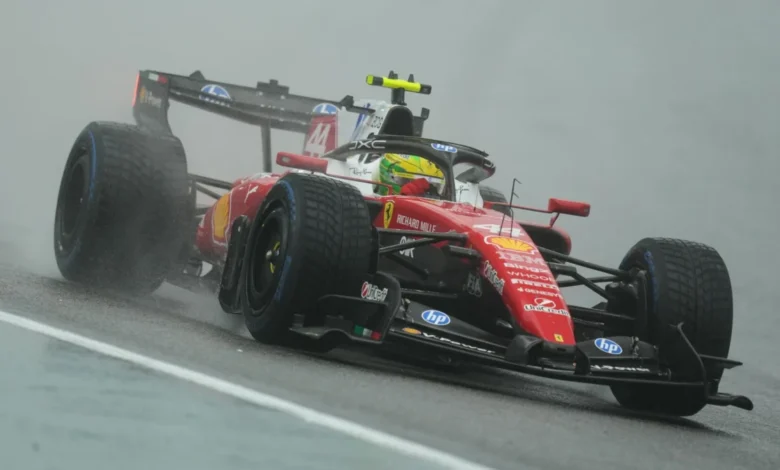
Rain at Interlagos is not merely a weather condition; it is a catalyst for legend. The circuit’s microclimate often produces localized downpours that can transition a track from bone-dry to treacherous in a matter of minutes. Both Hamilton and Verstappen have utilized these conditions in the past to perform near-miraculous recoveries.
Hamilton’s performance in the 2021 Sprint, where he sliced through the field from 20th to fifth, remains a benchmark for wet-weather mastery. However, the internal context for Ferrari is different this year. While the team has struggled for pace, the inherent volatility of wet racing offers an equalizer. Leclerc, often criticized for his consistency in wet conditions during his early years, is viewing this weekend as a learning laboratory. "My biggest strength in the junior categories was wet driving," Leclerc noted. "Since joining Ferrari, we have struggled to find a window for the car in these conditions. If we hit that window, we can fight for much better than a top-six finish."
For Norris, the prospect of a "dark, gloomy day" is a strategic preference. Recognizing that the McLaren, while improved with a suite of new aero components including a revised floor and beam wing, might lack the raw pace of the Mercedes in a clean, dry race, he is banking on the chaotic potential of precipitation. "I expect a battle no matter what," Norris admitted. "But in the dry, I expect a bigger battle. In the rain, it’s not about who has the best car; it’s about who can push to the absolute limit."
The Constructors’ Championship Equation
While the drivers are focused on the individual race, the corporate stakes are at their highest for the Mercedes-Ferrari rivalry. Mercedes enters the Sunday race with a golden opportunity to secure their ninth Constructors’ Championship since 2014.
The arithmetic is straightforward: if Mercedes can outscore Ferrari by three or more points, the title is theirs. With Antonelli starting second and Russell seventh, and the Ferraris buried in the pack, the mathematical probability of a Mercedes coronation is high. However, F1 is rarely dictated by probability. A single collision at the Senna S or a poorly timed pit stop in the rain could swing the momentum back to the Italian outfit.
A Weekend of Transitions
This triple-header represents the grueling nature of the modern F1 schedule, and the Sao Paulo Grand Prix acts as the final anchor before the season’s closing flyaways. The technical challenges this weekend—specifically the engine cooling in the high-altitude, thin air of São Paulo—have tested the reliability of all manufacturers. The decision by Red Bull and Ferrari to take engine penalties now is a calculated risk, likely aiming to ensure maximum performance for the final stretch of the season rather than attempting to nurse aging power units through to the finale.
As the teams finalize their setups for the 5pm start, the atmosphere in the paddock is one of tempered anticipation. The blend of a front row featuring the sport’s established star in Norris and its newest champion in Antonelli, contrasted with the recovery mission of veterans like Verstappen and Hamilton, ensures that the opening lap will be among the most scrutinized of the 2025 season.
Final Schedule and Viewing Information
The broadcast begins at 3.30pm with Grand Prix Sunday, providing comprehensive build-up to the main event. With the threat of rain hanging over the circuit, the technical analysis provided during the pre-race show will focus heavily on tire degradation rates in wet conditions and the specific engine maps required to manage the deployment of electrical energy through the tight corners of the final sector.
Sunday November 8 Schedule:
- 3.30pm: Grand Prix Sunday: Pre-race build-up
- 5.00pm: The Sao Paulo Grand Prix
- 7.00pm: Chequered Flag: Post-race analysis and interviews
- 8.00pm: Ted’s Notebook
As the lights go out, the focus will shift from the spreadsheets of the engineers to the steering inputs of the drivers. Whether it is a tactical masterclass in the dry or a high-variance battle in the rain, the Sao Paulo Grand Prix remains one of the most unpredictable and rewarding fixtures on the calendar. For the thousands of fans at Interlagos and the millions watching worldwide, the narrative of the 2025 season is reaching a crescendo in one of motorsport’s most storied arenas.