Erling Haaland haunts RB Leipzig once more to steer Manchester City to a dramatic 3-2 Champions League victory

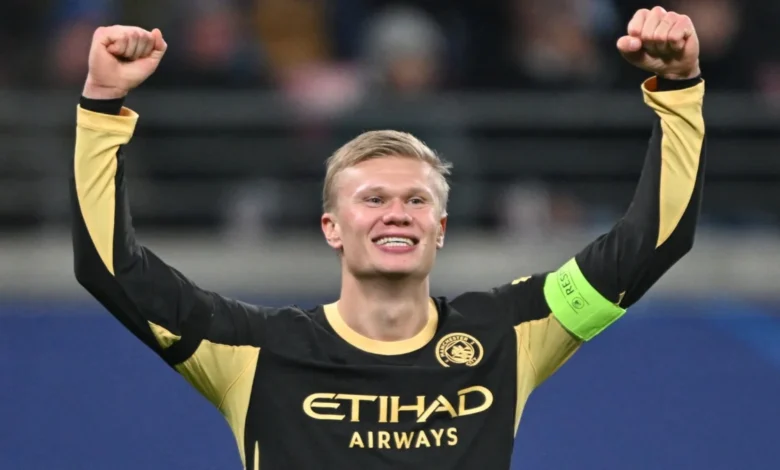
The Champions League continues to be a theater of the familiar for Erling Haaland, whose predatory instincts propelled Manchester City to a hard-fought 3-2 victory over RB Leipzig on a night defined by defensive fragility and attacking brilliance. In a contest that saw the momentum swing violently between the two sides, it was the Norwegian international who ultimately proved the difference, netting his 13th goal in just nine career appearances against the Bundesliga outfit—a record return that cements his status as Leipzig’s perennial tormentor.
The result serves as a vital restorative measure for Enzo Maresca’s side, who entered the fray under scrutiny following a disappointing domestic defeat to Brighton over the weekend. While the victory elevates City to seventh in the expansive Champions League league phase table, the performance raised lingering questions regarding the squad’s defensive cohesion and the consistency of their goalkeeping.
A First Half Defined by Luck and Tension
The opening period at the Red Bull Arena was characterized by a distinct lack of rhythm from the visitors, who struggled to impose their usual tactical dominance. Leipzig, buoyed by a fervent home support, initially dictated the pace, with Christoph Baumgartner and Antonio Nusa asking persistent questions of the City backline.
Despite Leipzig’s early ascendancy, the deadlock was broken in the 25th minute through a moment of misfortune rather than tactical ingenuity. Under pressure, Leipzig defender Castello Lukeba inadvertently turned a low ball into his own net, gifting Manchester City an opener that stood in stark contrast to the flow of the game. For the remainder of the first half, Haaland remained a peripheral figure, managing a mere three touches as the German side effectively congested the central areas of the pitch to neutralize the striker’s threat.
Tactical Shifts and Goalkeeping Woes
The second half began with a moment of high drama. Gianluigi Donnarumma, tasked with anchoring the City defense, produced an exceptional reaction save to deny Baumgartner from point-blank range, a moment that hinted at a potential clean sheet for the Italian. However, that sense of security was short-lived.
Moments later, the narrative shifted when Ridle Baku caught Donnarumma off guard at his near post. From an acute angle, Baku tucked the ball home, exploiting a gap in the goalkeeper’s positioning that stunned the traveling support. The goal underscored a recurring theme for City this season: a vulnerability in transition that has frequently invited pressure upon their own goal.
The game then descended into a chaotic, end-to-end spectacle. Sensing the need for urgency, Maresca’s side pushed forward with renewed vigor. The response was immediate: Enzo Fernandez, rising high in the box, connected with a sublime cross from Iliman Ndiaye to restore City’s lead. Yet, the parity remained fragile. Within three minutes, Leipzig responded again, with Nusa carving through the City defense to fire a clinical low effort past Donnarumma, leveling the score at 2-2.
The Decisive Contribution
With the match balanced on a knife’s edge, Maresca opted to introduce Jeremy Doku, whose injection of pace shifted the tactical landscape in City’s favor. The breakthrough finally arrived 12 minutes from time. Elliot Anderson, a standout performer who has transitioned seamlessly into the City setup, provided the decisive assist, delivering a low, pinpoint cross that found Haaland. For a striker of his caliber, the finish was a formality, tapping home to secure a lead that City would not relinquish.
The closing stages were defined by a frantic energy. David Raum rattled the woodwork for Leipzig, and Rayan Cherki saw a similar effort strike the frame for City, but the scoreline held, ensuring the visitors departed Germany with all three points.
Goalkeeping Scrutiny and Tactical Reflections
The performance of Gianluigi Donnarumma has become a focal point of post-match analysis. Critics have pointed to the Italian’s recurring lapses in concentration and uncertain handling as a significant liability for a team with title aspirations. His positioning for Baku’s goal was widely viewed as a fundamental error, and his general demeanor throughout the match suggested a lack of the composure expected at the elite level of European football.
Addressing the media post-match, Enzo Maresca maintained a pragmatic outlook, acknowledging the difficulty of playing away in the Champions League while emphasizing the need for greater control. "It was a tough game in some moments," Maresca stated. "We controlled quite well, but there were periods where we struggled. Leipzig is well-organized, aggressive, and dangerous on the break. We need to be more careful with our transitions, but I am happy with the three points."
Erling Haaland: A Statistical Phenomenon
Haaland’s post-match comments reflected both satisfaction with his individual record and a critical assessment of the team’s collective performance. Having now scored more goals against RB Leipzig than any other opponent in his professional career—dating back to his time with Borussia Dortmund—Haaland remains a unique outlier in European football.
"I think it is the most I have scored against a club," Haaland remarked. "I have played so many times against them in the Champions League. It is not easy to come here, but the result is what matters. However, we have to step up. When we are 1-0 up, we need to be more clinical. We have to go for the second and third goals to kill the game off. That is the standard we must maintain."
The Norwegian also took a moment to praise teammate Elliot Anderson, noting, "He has had an amazing start to his City career. It is not easy to adapt to a new coach and new teammates, but he has been impressive. He has my respect."
Broader Implications and Context
The victory provides Manchester City with a vital cushion in the league phase, but the underlying statistics suggest areas for urgent improvement. City’s propensity to concede in quick succession—as seen when Leipzig equalized just minutes after Fernandez’s goal—highlights a psychological frailty that could prove costly in the knockout stages of the tournament.
Furthermore, the integration of new signings like Anderson and Ndiaye is beginning to yield dividends, providing Maresca with more tactical versatility. However, the reliance on Haaland to bail out the side in moments of defensive uncertainty remains a double-edged sword. While his efficiency is unmatched, the team’s dependence on his individual brilliance may mask deeper structural issues that elite European opponents are likely to exploit.
As City prepares for their upcoming fixtures, the focus will likely shift to refining their defensive transition play. The Champions League format, with its high-stakes, high-intensity nature, leaves little margin for the kind of defensive lapses witnessed at the Red Bull Arena. For now, however, City can take solace in a result that keeps their European ambitions firmly on track, driven by a striker who shows no signs of slowing his prolific pace against his favorite opponents.
The upcoming matches will serve as a litmus test for Maresca’s tactical evolution. With the league phase table beginning to take shape, every point earned in hostile environments like Leipzig is invaluable. For Manchester City, the path forward is clear: maintain the clinical edge provided by Haaland, while tightening the defensive resolve required to compete for the ultimate prize in club football.