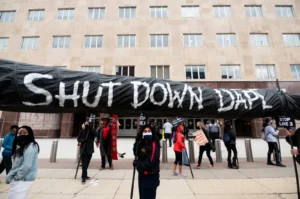
Federal Court Strikes Down Trump Administration Order Forcing Michigan Coal Plant to Remain Operational


The United States Court of Appeals for the D.C. Circuit delivered a significant legal rebuke to the Department of Energy on Friday, ruling that the agency overstepped its statutory authority when it compelled the continued operation of the J.H. Campbell coal-fired power plant in Michigan. The facility, which had been scheduled for decommissioning in May 2025, was forced to remain online under an emergency order issued by the Trump administration. This decision marks a pivotal moment in the ongoing national debate regarding the limits of executive power in the energy sector and the legal threshold required to justify federal intervention in private utility operations.
The ruling, authored by Judge Cornelia Pillard, clarified that the emergency powers granted under the Federal Power Act were intended to function as a narrow, last-resort backstop, rather than a broad tool for long-term energy policy. By rejecting the Department of Energy’s assertion that the demand for data center power and general grid reliability concerns constituted an "emergency," the court has introduced a significant hurdle for the administration’s broader strategy of maintaining fossil fuel assets that market forces had otherwise deemed obsolete.
A Chronology of the Emergency Mandate
The conflict traces its origins to the first day of President Donald Trump’s second term in January 2025, when he issued an executive order declaring a "national energy emergency." This directive served as the foundation for the Department of Energy to intervene in the operations of several aging power plants across the country.
In May 2025, just as the 64-year-old J.H. Campbell plant in West Olive, Michigan, was preparing to wind down its operations, the Department of Energy invoked its emergency powers. The administration argued that the regional grid required the continued output of the plant to prevent potential outages and to satisfy the ballooning energy demands of burgeoning data centers. This move was not an isolated incident; it was one of seven similar federal actions taken against fossil-fuel facilities nationwide.
The ensuing litigation, led by a coalition including the Environmental Defense Fund (EDF) and the Natural Resources Defense Council (NRDC), challenged the legal validity of these orders. The D.C. Circuit’s decision on Friday represents the first successful judicial pushback against this systematic application of emergency authority, effectively freezing the administration’s ability to use the same legal rationale in pending cases involving other coal-fired plants.
Environmental and Public Health Impacts
The continued operation of the J.H. Campbell plant has drawn intense scrutiny from environmental scientists and public health advocates. According to data provided by the Environmental Defense Fund, the facility has released a significant volume of pollutants since its forced extension. As of the end of June 2026, the plant had emitted approximately 1,000 tons of nitrogen oxides, 2,000 tons of sulfur dioxide, and 140 tons of particulate matter.
These pollutants carry direct consequences for the 3,000 residents living in the immediate vicinity of the West Olive plant. Estimates from the EDF suggest that this localized increase in emissions could contribute to roughly 100 new cases of asthma and other respiratory complications. Beyond the human toll, the economic implications are equally contentious. Consumers Energy Company, the utility operating the plant, has incurred an estimated $259 million in operational costs since the emergency order was issued. The utility is currently seeking to recover these expenses from its customer base, spanning Michigan and 10 other states, a move that has sparked outrage among consumer protection groups and state regulators.
Legal Analysis and Regulatory Precedent
The core of the legal dispute hinges on the definition of "emergency" under the Federal Power Act. While the administration maintained that the need for increased baseload power—driven by the rapid expansion of artificial intelligence infrastructure and data centers—justified the intervention, the court disagreed.
"You can say there’s an energy emergency as much as you want—even if you’re the president," said Ted Kelly, director and lead counsel for U.S. Clean Energy at the Environmental Defense Fund. "But what you can actually do depends on what the real facts on the ground are and what the law actually lets you do in different situations."
Legal experts suggest that the D.C. Circuit ruling establishes a new, higher standard for the federal government. By defining the emergency statute as a "last-resort backstop," the court has signaled that economic convenience or administrative preference for certain fuel types does not meet the legal threshold for overriding plant retirement schedules.
Gavin McCabe, senior litigating counsel at the NRDC, noted that while the ruling does not force an immediate shutdown of the J.H. Campbell plant, it provides a powerful legal framework for future challenges. The administration retains the option to request a rehearing or appeal to the Supreme Court, which could stall the closure process for months or years. However, the ruling creates a "chilling effect" on the administration’s other ongoing efforts to keep fossil fuel plants online. Multiple lawsuits against similar facilities across the U.S. have been held in abeyance pending the outcome of this specific case, and those cases now lean heavily toward the plaintiffs.
Contradictions in Energy Policy
The administration’s focus on maintaining aging coal infrastructure appears to exist in stark contrast to its simultaneous efforts to curb the expansion of renewable energy. Reports indicate that by mid-August 2026, the administration had committed approximately $4 billion in payouts to various entities specifically to halt or delay offshore wind projects. Industry analysts estimate that these canceled projects had the capacity to power more than 15 million homes, potentially alleviating the very grid reliability concerns the administration cited to justify the coal plant extensions.
This perceived inconsistency has fueled allegations that the "energy emergency" designation is a political pretext rather than a grid-management necessity. "Why would the administration be blocking sources of energy that are ready to come online in favor of keeping online something that has been set to be retired?" McCabe questioned. "There appears to be a pretext that the president wants to help coal industry supporters. And this is one of the ways to attempt to do that."
Broader Implications for the Utility Sector
The fallout from this ruling extends far beyond the J.H. Campbell plant. Utility companies, which generally prefer to retire inefficient, high-emission assets in favor of more cost-effective natural gas or renewable alternatives, now find themselves caught between federal mandates and state-level regulatory pressure.
In Michigan, the Public Service Commission and other state-level bodies have been monitoring the situation closely. If the federal mandate is ultimately overturned or vacated, it will trigger a complex process of determining how the $259 million in accumulated costs will be allocated. Utilities may face significant financial exposure if they are barred from passing these "emergency" costs on to consumers, potentially necessitating a restructuring of their regional power delivery strategies.
Furthermore, the ruling serves as a signal to the power industry that the courts will be an active participant in the transition of the U.S. energy grid. As the nation grapples with the dual challenges of meeting rising electricity demand and reducing carbon emissions, the role of executive agencies in "picking winners and losers" among energy sources will likely remain a central point of contention in federal courtrooms.
For now, the J.H. Campbell plant continues to burn coal, but the legal foundation supporting its operation has been severely compromised. The path forward remains uncertain, pending potential appeals, but the D.C. Circuit has effectively drawn a line in the sand: emergency powers, while potent, are not limitless, and the executive branch must provide tangible, evidence-based justifications when intervening in the long-term planning of the American energy market.