Notion Habit Tracker Templates

Unlock Your Potential with Notion Habit Tracker Templates
Notion habit tracker templates represent a powerful and versatile solution for individuals and teams aiming to cultivate positive behaviors, break negative patterns, and achieve their goals. By leveraging the flexibility of Notion, a popular all-in-one workspace application, users can design highly personalized and visually appealing habit tracking systems. These templates go beyond simple checkboxes, offering integrated journaling, goal setting, progress visualization, and even accountability mechanisms. The core benefit lies in transforming abstract aspirations into concrete, actionable steps that can be consistently monitored and improved upon. This article will delve deep into the various aspects of Notion habit tracker templates, exploring their advantages, common features, customization options, implementation strategies, and how to select the most suitable template for individual needs.
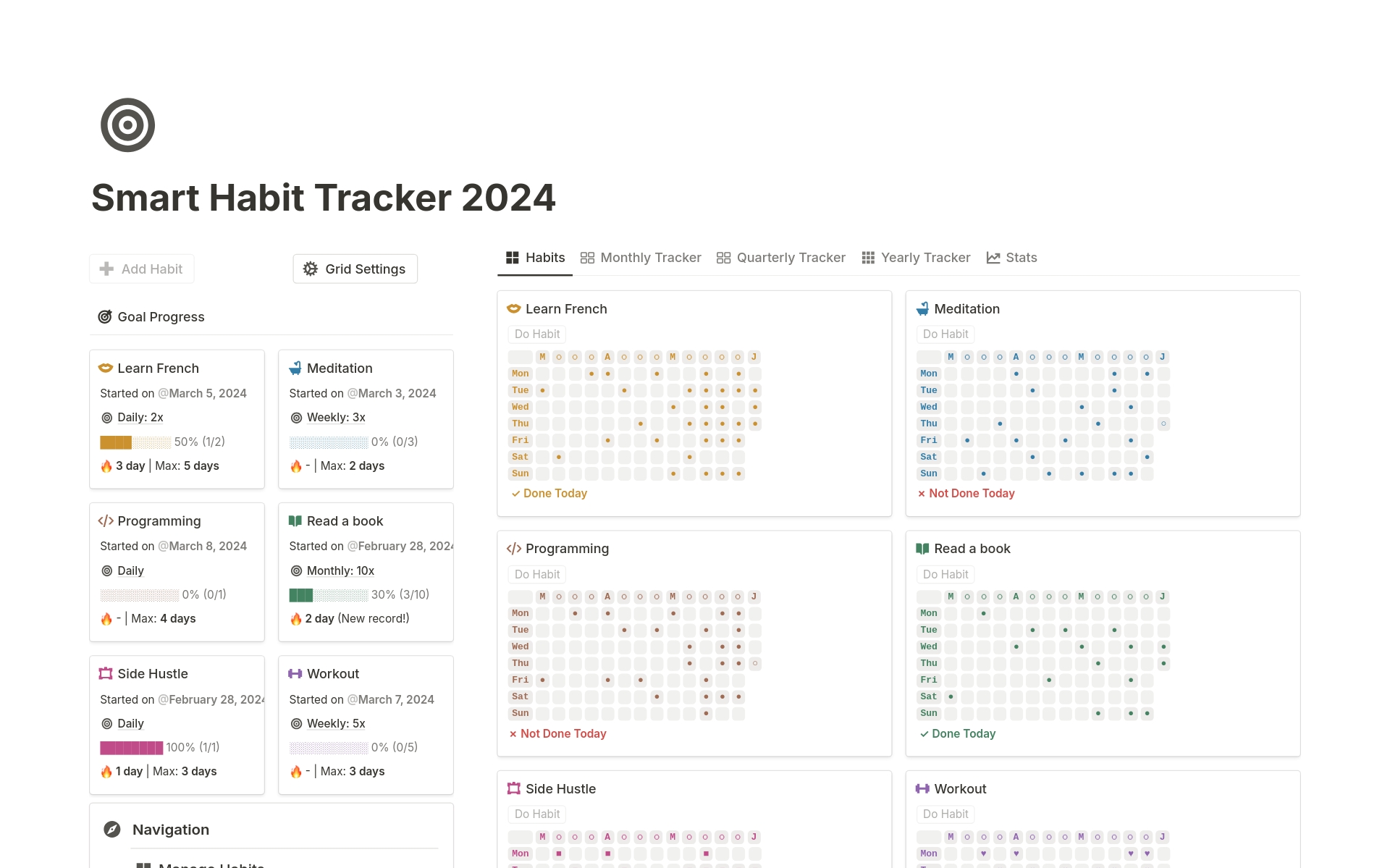
The inherent strength of Notion habit tracker templates lies in their adaptability. Unlike rigid, pre-defined apps, Notion allows for a degree of customization that mirrors the unique journey of each user. Whether the goal is to drink more water, meditate daily, read a chapter of a book, or learn a new skill, a Notion template can be tailored to fit. The platform’s database functionality is central to this adaptability. Each habit can be treated as an entry within a database, with properties such as frequency (daily, weekly, monthly), target completion, start date, end date, and even a checkbox for completion. This structured approach ensures that all relevant information is organized and readily accessible, facilitating a clear overview of progress and areas for improvement. Furthermore, Notion’s ability to create linked databases allows for more complex tracking, such as linking habits to larger goals or projects, creating a holistic system for personal development.
Common features found within effective Notion habit tracker templates often include a dashboard view, which provides a high-level overview of all active habits, their current status, and upcoming tasks. This can be presented as a calendar, a Kanban board, or a simple list, allowing users to quickly assess their daily or weekly commitments. A dedicated "Today" or "This Week" view is crucial for immediate action, highlighting habits that require attention on the current day. Many templates incorporate journaling prompts or dedicated sections for reflection, encouraging users to not only log completion but also to document their experiences, challenges, and insights related to each habit. This qualitative data adds significant depth to the tracking process, enabling users to understand the underlying reasons for success or failure. Progress visualization is another key element, with templates often utilizing charts, graphs, or even simple progress bars to illustrate streaks, completion rates, and overall momentum. This visual feedback is a powerful motivator, reinforcing positive behaviors and providing tangible evidence of progress.
Customization is where Notion habit tracker templates truly shine. Users are not limited to pre-set habit categories. They can create entirely new habits, define their own metrics for success, and even assign different tracking methods. For instance, one habit might be a simple daily checkbox, while another could involve logging a specific number of hours or completing a qualitative task. The ability to add custom properties, such as "priority," "difficulty level," or "associated resources," further enhances the personalization. For example, a "read for 30 minutes" habit could have a "book title" property, allowing users to track their reading progress across different titles within the same habit. Furthermore, Notion’s rich text editing capabilities allow for the inclusion of detailed instructions, motivational quotes, or links to relevant external resources directly within the habit entry. This means a habit tracker can become a comprehensive personal development hub, not just a logging tool.
Implementing a Notion habit tracker effectively involves more than just downloading a template. It requires a mindful approach to habit selection and integration into daily routines. The first step is to identify realistic and achievable habits. Overcommitting can lead to discouragement and abandonment. Starting with a few core habits and gradually adding more as proficiency increases is a recommended strategy. Secondly, consistency is paramount. Users should establish a regular time and method for logging their habits. Integrating this into an existing morning or evening routine can significantly improve adherence. For example, logging water intake can be done immediately after waking up, and reviewing daily progress can be part of an end-of-day wind-down. The visualization features of Notion are crucial here; seeing a growing streak can be a powerful incentive to continue. Furthermore, using the journaling features to reflect on why a habit was missed or what made it successful can provide invaluable insights for future adjustments.
When selecting a Notion habit tracker template, consider the complexity of your needs and your preferred user interface. For beginners, simpler templates with clear layouts and intuitive navigation are advisable. These often focus on core habit tracking with basic journaling. As users become more comfortable with Notion, they might seek out templates that offer more advanced features like goal integration, project linking, or sophisticated progress analytics. The availability of pre-built dashboards, customizable views (Kanban, calendar, gallery), and integration with other Notion pages (e.g., a master goal list or a project management system) are important factors to consider. Many creators offer free templates, while others provide premium versions with enhanced features, detailed instructions, and ongoing support. Exploring template marketplaces and communities can offer a wide array of options tailored to different preferences and objectives.
The SEO-friendliness of Notion habit tracker templates stems from their inherent structure and the potential for rich content creation. Properly tagged databases, clear page titles, and descriptive property names contribute to discoverability within Notion itself and for external search engines if shared publicly. For individuals using these templates for personal organization, the focus is on creating searchable and easily retrievable information. For creators and businesses offering these templates, optimizing descriptions with relevant keywords such as "Notion habit tracker," "personal development template," "goal setting tool," "productivity system," and specific habit types (e.g., "meditation tracker Notion") will improve their visibility. Furthermore, the ability to embed rich media, write detailed guides within the template itself, and link to external blog posts or resources further enhances SEO potential.
Beyond simple habit tracking, Notion templates can evolve into comprehensive personal operating systems. By linking habit databases to goal databases, project management boards, and even financial trackers, users can create a unified system that supports their holistic growth. For instance, a "daily exercise" habit could be linked to a larger fitness goal, which in turn is linked to specific workout sessions managed in a separate project database. This interconnectedness ensures that daily actions are directly contributing to overarching objectives, fostering a sense of purpose and direction. The flexibility of Notion also allows for the creation of accountability partners. Users can share specific pages or databases with friends or colleagues, fostering mutual support and shared progress. This collaborative element can significantly boost motivation and adherence.
The process of building a Notion habit tracker from scratch, or heavily customizing an existing template, offers a profound learning experience. It forces users to critically assess their habits, their goals, and their underlying motivations. This introspection is a crucial component of personal development. As users refine their templates, they gain a deeper understanding of their own behavioral patterns, their triggers, and their optimal working conditions. This self-awareness is invaluable for long-term success in habit formation and goal achievement. The digital nature of Notion also offers a significant advantage over physical planners. Habits can be tracked, analyzed, and adjusted instantaneously without the need for manual rewriting or erasing. Data can be easily exported for further analysis, and the system can be backed up to prevent data loss.
Moreover, the aesthetic appeal of Notion templates can play a surprising role in user engagement. Visually pleasing dashboards, well-organized layouts, and the use of icons and color-coding can make the process of habit tracking more enjoyable and less of a chore. This gamification element, combined with the satisfaction of seeing streaks grow and goals being met, can create a positive feedback loop that encourages continued engagement. The ability to create recurring tasks and reminders within Notion ensures that users are prompted at the right time, reducing the likelihood of forgetting to log a habit. This proactive approach is a cornerstone of successful habit formation.
The scalability of Notion habit tracker templates is another significant advantage. As an individual’s goals and habits evolve, the template can be adapted and expanded to accommodate these changes. What starts as a simple daily water intake tracker can grow into a comprehensive wellness dashboard that includes sleep tracking, meal logging, and mood journaling. For teams, a shared Notion workspace can serve as a central hub for collaborative habit building, fostering a culture of accountability and shared progress towards common objectives. The potential for integration with other tools and applications, through APIs and third-party services, further expands the capabilities of Notion habit trackers, allowing them to become integral parts of a broader digital ecosystem. The continuous development of Notion itself means that new features and functionalities are regularly introduced, further enhancing the power and versatility of these templates. This ongoing evolution ensures that Notion habit trackers remain at the forefront of personal and professional development tools.