Frozen Secrets of Enceladus: How Laboratory Experiments Reveal the Complex History of Saturn’s Ocean World

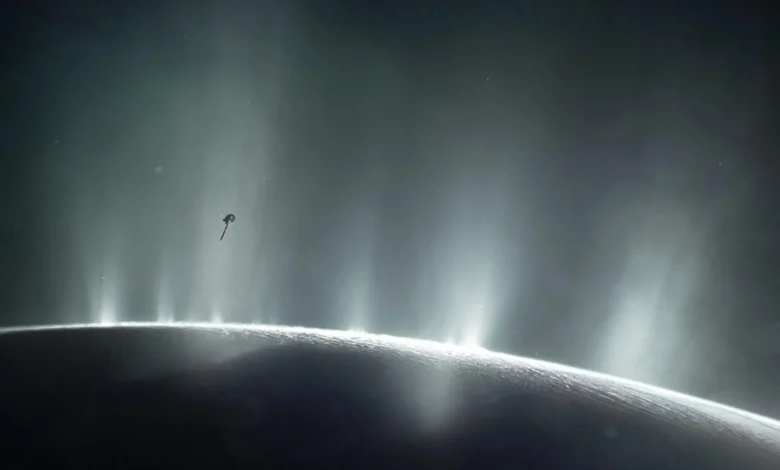
The icy moon Enceladus, a small but geologically active satellite of Saturn, has long been a focal point for astrobiologists searching for life beyond Earth. Hidden beneath a global shell of ice lies a liquid water ocean, an environment that interacts with the moon’s rocky core to create a chemical-rich interior. For years, scientists have puzzled over the composition of the plumes of ice and water vapor that erupt from the moon’s southern polar region. New research led by an international team, including investigators from the Earth-Life Science Institute (ELSI) at the Institute of Science Tokyo, suggests that these plumes provide a far more complex data set than previously realized. By recreating the freezing processes of Enceladus’ ocean water in a laboratory, researchers have discovered that the chemical diversity observed in Saturn’s E-ring is a direct result of how ocean droplets freeze and fragment as they travel toward the surface.
The Legacy of the Cassini Mission
Between 2004 and 2017, NASA’s Cassini spacecraft conducted an extensive survey of the Saturnian system. One of its most significant achievements was the analysis of the E-ring, a diffuse, faint ring composed of microscopic ice grains. Scientists determined that these grains were not primordial material left over from the formation of the solar system, but rather fresh material being constantly replenished by the cryovolcanic plumes of Enceladus.
The spacecraft’s Cosmic Dust Analyzer (CDA) was instrumental in this discovery, capturing and analyzing individual ice particles as the probe flew through the ring. When the data from these encounters were analyzed, researchers identified a specific class of "Type 3" particles—salt-rich grains that offered a window into the composition of the moon’s hidden ocean. A team led by Professor Frank Postberg of Freie Universität Berlin meticulously examined 961 mass spectra from these grains. If the plumes were merely a uniform spray of bulk ocean water, the grains would logically possess a relatively homogeneous composition. Instead, the data revealed a startling chemical variety. Some particles were heavily enriched in sodium chloride, while others contained distinct concentrations of carbonates, phosphates, or potassium chloride. A particularly puzzling observation was the mutual exclusivity of chloride and carbonate in many of these sodium-rich grains.
Laboratory Simulations of Alien Oceans
To reconcile these observations with the known laws of aqueous chemistry, Professor Yasuhito Sekine and his team at ELSI sought to simulate the journey of ocean droplets from the seafloor to the vacuum of space. The experimental setup involved creating laboratory droplets that mimicked the presumed salt content of the Enceladus ocean. These droplets were subjected to varying cooling rates to observe how solutes—the salts and organic compounds—reorganized as the liquid transitioned into a solid state.
The findings demonstrated that the physical kinetics of freezing are the primary drivers of chemical segregation. When the researchers subjected 200-micrometer droplets to slow cooling—approximately 10 Kelvin per minute or less—the chemical ingredients separated into distinct regions within the droplet. In contrast, rapid freezing resulted in a more uniform distribution of salts. This suggests that if the ocean spray from Enceladus undergoes a slow, controlled freezing process, it effectively "fractionates" the solutes, creating pockets of high salt concentration separated by regions of relatively pure ice.
A New Model for the Vent System
This discovery forces a reassessment of the physical environment within the icy crust of Enceladus. Previous models generally assumed that the spray from the subsurface ocean accelerated rapidly through the vents, freezing almost instantly upon exposure to the near-vacuum of the lunar surface. The new experimental data, however, supports a more nuanced "slow-transit" scenario.
In this updated model, water from the ocean forms droplets ranging from tens to hundreds of micrometers in diameter. Rather than a quick burst, these droplets undergo a protracted journey through the labyrinthine fracture systems within the moon’s icy shell. As they move through the deeper, cooler sections of the conduits, they begin a gradual freezing process. This allows for the internal migration and concentration of salts.
As these partially frozen droplets near the surface, the physical conditions become more violent. Gas pressure within the vents increases, accelerating the flow and forcing the droplets to collide with the walls of the narrow icy channels. These high-speed impacts shatter the frozen droplets into smaller fragments. Because each fragment is a piece of a previously segregated droplet, each grain carries a different chemical signature. This explains why Cassini detected such high chemical diversity: it was sampling the broken, distinct "neighborhoods" of once-larger droplets.
Implications for Future Exploration
The ability of Enceladus to naturally separate and concentrate its own chemical constituents has profound implications for future astrobiological missions. One of the greatest challenges in space exploration is the low concentration of target molecules in a sample; often, trace organics or biomarkers are masked by the bulk composition of the matrix in which they are suspended.
If Enceladus acts as a natural laboratory for "sample preparation," future landers or fly-by probes might find their work significantly simplified. By targeting specific types of ice grains, scientists could isolate samples where organic compounds have been naturally concentrated to levels far higher than those found in the bulk ocean. This phenomenon mirrors the techniques used in terrestrial analytical laboratories, where complex mixtures are filtered or centrifuged to isolate specific chemical fractions.
Furthermore, the freezing process may provide a mechanism for prebiotic chemistry to flourish. As ice crystals expand during slow freezing, they create "brine pockets"—microscopic, high-salinity environments where organic molecules are brought into close proximity. In a dilute, large-scale ocean, such molecules might never encounter one another; within the confines of an ice-trapped brine pocket, the probability of chemical reactions increases exponentially. Because much of the ejected material falls back onto the surface of Enceladus, this cycle of freezing, concentrating, and recycling may provide a sustained environment for the development of the chemical precursors of life.
Analysis and Concluding Remarks
The research conducted by the ELSI and Freie Universität Berlin teams shifts the paradigm of Enceladus from a simple geological curiosity to a sophisticated chemical factory. The correlation between the Cassini data and the laboratory freezing experiments provides a robust physical explanation for the observed chemical anomalies.
This study also underscores the necessity of high-resolution in-situ analysis for future missions. While current data provided a foundational understanding, the next generation of spacecraft—equipped with more advanced mass spectrometers—will need to account for the physical state of the particles they collect. Understanding the "history" of a grain—whether it is a pristine sample of the ocean or a fragmented, segregated piece of a frozen droplet—will be vital for interpreting the data correctly.
As humanity continues to look toward the outer solar system, Enceladus remains a prime candidate for the discovery of extraterrestrial life. By understanding the mechanical and chemical processes that govern the transport of its ocean materials into space, scientists are not only learning about the moon’s past but are also preparing the tools necessary to detect the potential for life in its hidden, liquid heart. The evidence suggests that the ice grains orbiting Saturn are not just debris; they are deliberate, concentrated archives of the moon’s internal chemistry, waiting to be fully read.