U.S. Supreme Court Hands Michigan Major Victory in Fight to Shut Down Line 5 Pipeline by Sending Dispute to State Court

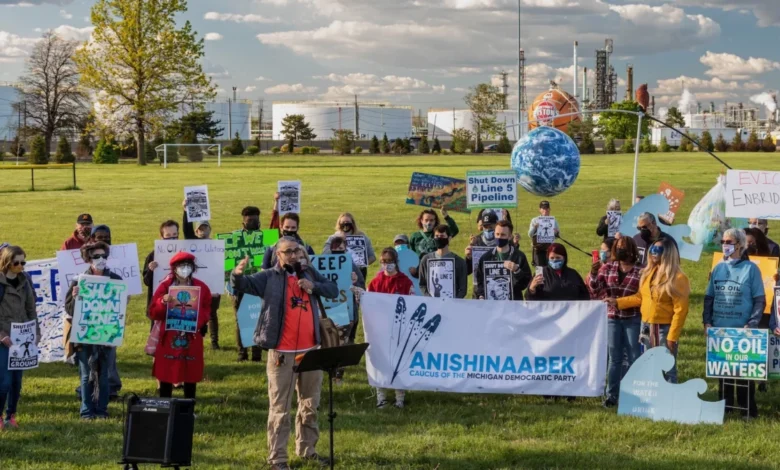
In a unanimous and consequential decision, the United States Supreme Court has ruled that Michigan’s long-standing legal challenge to shut down the Line 5 oil pipeline must be heard in state court, a move that significantly strengthens the position of state officials and environmental advocates. The ruling, authored by Justice Sonia Sotomayor, rejects attempts by the Canadian energy giant Enbridge to move the litigation into the federal court system, effectively clearing the path for Michigan judges to determine whether the aging pipeline poses an unacceptable risk to the Great Lakes. This procedural victory for Michigan Attorney General Dana Nessel represents a pivotal moment in a multi-year battle that intersects international diplomacy, tribal sovereignty, and the environmental security of the world’s largest freshwater system.
The dispute centers on a 4.5-mile segment of the Line 5 pipeline that rests on the lakebed of the Straits of Mackinac, the narrow waterway connecting Lake Michigan and Lake Huron. For years, the state has argued that the dual pipelines, which have been in operation since 1953, are a "ticking time bomb" that threatens to cause a catastrophic oil spill. Enbridge, conversely, maintains that the pipeline is safe and essential for the energy needs of both the Midwestern United States and Central Canada. By keeping the case in state court, the Supreme Court has prioritized state oversight of its own natural resources, a decision that legal experts believe could have far-reaching implications for how states manage environmental risks posed by interstate and international infrastructure.
The Jurisdictional Battle: Why Venue Matters
The Supreme Court’s decision was focused specifically on the procedural question of jurisdiction rather than the merits of whether the pipeline should be shut down. Enbridge had sought to "remove" the case from Michigan’s 30th Circuit Court to a federal venue, arguing that the dispute involves federal safety standards and a 1977 treaty between the United States and Canada regarding the transit of hydrocarbons. Enbridge’s legal team contended that because the pipeline is part of an international network, state courts lack the authority to unilaterally order its closure.
However, Justice Sotomayor, writing for the unanimous court, noted that Enbridge had waited too long to seek this move. Under federal law, parties generally have a 30-day window to move a case to federal court once the grounds for doing so become apparent. The Court found that Enbridge’s arguments for the delay were "not persuasive," effectively punishing the company for what critics have called "delay tactics" intended to keep the pipeline operating while legal proceedings drag on.
For Michigan, the preference for state court is rooted in the "Public Trust Doctrine," a legal principle asserting that the state has a sovereign duty to protect its navigable waters for the benefit of the public. Attorney General Nessel has argued that the 1953 easement granted to Enbridge to lay the pipeline was a violation of this trust. State courts are traditionally seen as the more appropriate venue for interpreting state-specific property laws and environmental protections.
A Chronology of the Line 5 Conflict
The legal and political fight over Line 5 has evolved over several decades, intensifying as the infrastructure aged and environmental awareness grew.
- 1953: The Line 5 pipeline is constructed by the Bechtel Corporation for Enbridge (then Lakehead Pipe Line Company). The dual pipelines are laid across the Straits of Mackinac under an easement granted by the State of Michigan.
- 2010: The Enbridge Line 6B spill in the Kalamazoo River, one of the largest inland oil spills in U.S. history, heightens public anxiety regarding Enbridge’s aging infrastructure in Michigan.
- 2017-2018: Under the administration of former Governor Rick Snyder, the state reaches an agreement with Enbridge to replace the lakebed segments with a new pipeline housed in a concrete-lined tunnel deep beneath the lakebed.
- 2019: Newly elected Attorney General Dana Nessel files a lawsuit to revoke the 1953 easement and shut down the pipeline, citing the "grave risk" of a spill.
- 2020: Governor Gretchen Whitmer issues an executive order to terminate the easement and demands that Enbridge cease operations by May 2021. Enbridge ignores the order, leading to a flurry of lawsuits in both state and federal courts.
- 2021-2023: The Canadian government formally invokes the 1977 Transit Pipeline Treaty, elevating the dispute to a diplomatic level between Washington and Ottawa.
- 2024: The U.S. Supreme Court takes up the jurisdictional question, leading to the current ruling that remands the case to Michigan state courts.
Technical Specifications and Environmental Risks
Line 5 is a 645-mile pipeline that transports up to 540,000 barrels (22.7 million gallons) of light crude oil and natural gas liquids per day. It runs from Superior, Wisconsin, through Michigan’s Upper Peninsula, under the Straits of Mackinac, and down through the Lower Peninsula to Sarnia, Ontario.
The primary point of contention is the Straits of Mackinac segment. This area is characterized by powerful, complex currents that can change direction frequently, potentially making an oil spill cleanup nearly impossible, especially during winter months when ice covers the water. A 2016 study by the University of Michigan’s Water Center concluded that the Straits are the "worst possible place" for an oil spill in the Great Lakes. Researchers estimated that a major breach could impact more than 700 miles of shoreline in Michigan, Wisconsin, and Ontario.
The pipeline’s age is also a factor. While Enbridge maintains that the steel is in good condition and regularly inspected, the pipeline has suffered numerous "strikes" from ship anchors and cables over the years. In 2018, a tugboat anchor dented the pipeline, though no leak occurred. This incident fueled the state’s argument that the pipeline is vulnerable to external damage that is beyond the operator’s total control.
Tribal Sovereignty and Treaty Rights
The Supreme Court’s decision has been hailed as a major victory by the 12 federally recognized tribes in Michigan. These tribes, including the Bay Mills Indian Community and the Sault Ste. Marie Tribe of Chippewa Indians, have been among the most vocal opponents of Line 5.
For the tribes, the issue is not just environmental but legal and spiritual. The 1836 Treaty of Washington guaranteed the tribes the right to hunt, fish, and gather in the waters of the Great Lakes. A spill in the Straits would devastate the commercial and subsistence fishing industries that are central to tribal economies and cultural identities.
Whitney Gravelle, President of the Bay Mills Indian Community, emphasized that the shift to state court allows for a broader discussion of these treaty rights. "It will really create space now for tribes to uplift their voices in the proceedings," Gravelle stated. She noted that state courts are often more attuned to the historical context of tribal land and water rights within the state’s borders than federal courts, which often focus on narrower regulatory interpretations.
Economic Implications and the Canadian Perspective
While the ruling is a blow to Enbridge, the company continues to defend the pipeline’s necessity. Line 5 is a critical piece of energy infrastructure for the region. It supplies approximately 50% of the propane used for home heating in Michigan’s Upper Peninsula and serves as a primary source of crude oil for refineries in Ontario and Quebec.
The Canadian government has remained a steadfast supporter of the pipeline. Officials in Ottawa argue that a shutdown would cause significant economic disruption, increase fuel prices, and threaten energy security in Central Canada. They maintain that the 1977 Transit Pipeline Treaty prohibits any state or local authority from interfering with the flow of hydrocarbons through international pipelines.
In response to the Supreme Court ruling, Enbridge spokesperson Ryan Duffy pointed to a separate federal court ruling from the Sixth Circuit Court of Appeals, which suggested that federal oversight of pipeline safety takes precedence. Enbridge remains hopeful that the federal government’s Pipeline and Hazardous Materials Safety Administration (PHMSA) will continue to find no safety issues that warrant a shutdown.
The Great Lakes Tunnel Project: A Parallel Path
Despite the litigation, Enbridge is moving forward with its plan to build the Great Lakes Tunnel. This $500 million project involves boring a tunnel 60 to 100 feet beneath the lakebed to house a new segment of the pipeline. Enbridge argues that the tunnel would virtually eliminate the risk of an anchor strike or a leak into the water.
The project is currently in the permitting phase. The Michigan Public Service Commission approved a permit for the tunnel in 2023, but that decision is being challenged in the Michigan Supreme Court by environmental groups and tribes. Federal permits from the U.S. Army Corps of Engineers are still pending, with a decision expected as early as mid-2025.
Opponents of the tunnel argue that it would lock Michigan into decades of continued fossil fuel reliance at a time when the state is attempting to transition to renewable energy. They also express concern that the construction of the tunnel itself could damage the delicate ecosystem of the Straits.
Analysis of Implications and Future Outlook
The U.S. Supreme Court’s decision to remand the case to state court is a significant tactical win for Attorney General Nessel, but it does not end the war. The case will now return to Michigan’s 30th Circuit Court, where Judge James Jamo will eventually weigh the state’s request to shut down the line.
However, several hurdles remain. First, the case is likely to be stayed (paused) until the Sixth Circuit Court of Appeals resolves a separate but related lawsuit involving Governor Whitmer’s 2020 shutdown order. If the Sixth Circuit rules that the state lacks the authority to regulate pipeline safety due to federal preemption, the state court’s power to order a shutdown could be severely limited.
Furthermore, the diplomatic tension between the U.S. and Canada adds a layer of complexity that state courts are rarely equipped to handle. If a Michigan judge orders a shutdown, the Biden administration—or a future administration—may be forced to intervene to uphold treaty obligations with Canada.
For now, the ruling represents a restoration of state agency. It affirms that when a state’s most precious natural resources are at stake, the state’s own legal system has a right to be the first arbiter of the law. As the litigation moves back to Lansing, the eyes of the environmental community, the energy sector, and international diplomats will remain fixed on Michigan. The ultimate fate of Line 5 will not only determine the environmental future of the Great Lakes but will also set a precedent for the balance of power between corporations, states, and sovereign tribal nations in the 21st century.