Long-Duration X-ray Flashes Reveal the Violent Birth of Magnetars Following Neutron Star Collisions

For decades, the high-energy sky was viewed through a narrow lens defined by the fleeting nature of gamma-ray bursts. Astronomers have long relied on these sub-two-second flashes of high-frequency radiation to pinpoint the catastrophic collisions of neutron stars—the ultra-dense, city-sized remnants of once-massive stars. However, a landmark study published in Science Bulletin has fundamentally expanded this perspective, revealing that these cosmic graveyards may produce a secondary, more enduring signal: an X-ray flash that persists for minutes rather than milliseconds. This discovery not only provides a new methodology for identifying neutron star mergers but also offers a rare, real-time glimpse into the birth of a magnetar.
The breakthrough is centered on a transient event designated EP250704a/GRB 250704B, detected on July 4, 2025. While the initial gamma-ray signature lasted only half a second, the Einstein Probe—a satellite launched in early 2024 specifically designed to survey the X-ray sky—recorded a sustained, brilliant emission of X-rays that lasted for nearly ten minutes. This observation constitutes the longest-lasting prompt X-ray flash ever associated with a binary neutron star merger, challenging existing models of how these stellar remnants behave in the immediate aftermath of a collision.
A Chronology of the Discovery
The identification of EP250704a/GRB 250704B began with the Einstein Probe’s wide-field monitoring capabilities. Upon the detection of the transient, a global network of rapid-response instruments was triggered. Professor Eleonora Troja’s research group, supported by a European Research Council Consolidator grant, spearheaded the follow-up efforts.
The timeline of the event illustrates the urgency required in modern time-domain astronomy. For graduate student Niccolò Passaleva, the notification arrived while he was commuting by train. Despite the logistical challenges, Passaleva and his colleagues successfully coordinated the deployment of the European Southern Observatory’s Very Large Telescope (VLT) in Chile and the Very Large Array (VLA) within minutes of the initial alert. This rapid response allowed the team to capture the event while it remained at its peak luminosity, providing the high-resolution data necessary to distinguish between various progenitor models.
By utilizing the VLT’s X-Shooter instrument, the researchers performed spectroscopy on the decaying light. They identified specific absorption patterns, which allowed for a precise calculation of the event’s redshift—z=0.6610. This measurement places the source of the flash more than six billion light-years away, indicating that the observed light began its journey across the cosmos when the universe was significantly younger than it is today.
The Case Against the Supernova
A central challenge in classifying fast X-ray transients is distinguishing them from other high-energy phenomena, such as the core-collapse supernovae of massive stars. Long-duration X-ray signals are frequently associated with the explosive death of massive stars, where the collapsing core produces a fireball that emits X-rays over several minutes.
To rule out this possibility, the research team utilized the VLT’s FORS2 instrument to conduct deep imaging of the site. If the event had been a standard supernova, the resulting explosion would have left behind a bright, observable optical glow. The absence of any such signal provided the "smoking gun" evidence the researchers needed. By combining the measured distance, the lack of an optical supernova counterpart, and the unique temporal profile of the X-ray flash, the team concluded that the event was almost certainly the result of a binary neutron star merger.
The Magnetar Hypothesis
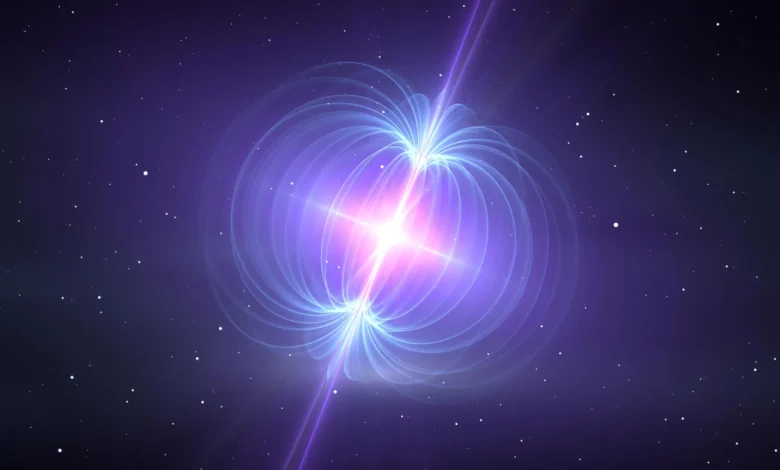
The implications of this study center on the nature of the object left behind by the collision. When two neutron stars merge, they typically form either a larger, hyper-massive neutron star or a black hole. If the resulting remnant is a magnetar—a neutron star possessing an exceptionally intense magnetic field—the physics of the aftermath changes dramatically.
"Magnetars are rapidly spinning neutron stars with huge magnetic fields," explains Professor Troja. "When they damp their magnetic power into the surroundings, they can make any explosion brighter and longer-lasting."
In this scenario, the initial half-second gamma-ray burst represents the immediate collision and merger, while the subsequent ten-minute X-ray emission represents the magnetar’s energy dissipation. This energy release acts as a beacon, revealing the presence of a remnant that would otherwise be difficult to detect. This discovery suggests that many of the "unexplained" fast X-ray transients detected by the Einstein Probe since its launch may, in fact, be the signatures of newly formed magnetars across the distant universe.
Scientific Context and Broader Implications
The field of multi-messenger astronomy—the study of the universe using both electromagnetic radiation and gravitational waves—has been dominated by the search for neutron star mergers. Until now, the primary tools for identifying these events have been gravitational wave detectors like LIGO, Virgo, and KAGRA, often coupled with short-duration gamma-ray bursts.
The addition of long-duration X-ray flashes to this toolkit offers several distinct advantages:
- Increased Detection Rates: While gravitational wave detectors are limited by their sensitivity and range, the Einstein Probe provides a wide-field, high-cadence X-ray survey that can identify events in regions of the sky currently beyond the reach of current gravitational wave detectors.
- Characterizing Remnants: By analyzing the duration and intensity of the X-ray tail, astronomers can infer the properties of the magnetic fields of these newly formed magnetars, providing insights into the equation of state of nuclear matter at extreme densities.
- Refining Progenitor Models: The ability to rule out supernovae with high certainty allows for a cleaner census of stellar populations in the early universe.
The research team, which includes an international collaboration of astronomers from institutions such as Beijing Normal University, the Chinese Academy of Sciences, the University of Rome Tor Vergata, and the University of Hong Kong, has already initiated a "QUEENB" (QUEst for Elusive Neutron star and Black hole mergers) program to standardize these observations.
Future Directions
The success of the observation of EP250704a/GRB 250704B underscores the effectiveness of current satellite-to-ground communication pipelines. However, the researchers are looking ahead to the next generation of gravitational wave detectors. The goal is to obtain a "coincident detection," where an X-ray flash is paired with a specific gravitational wave signature from the same event. Such a correlation would allow for an unprecedented measurement of the energy budget of the merger, potentially answering fundamental questions about how much mass is ejected during the collision versus how much is retained by the magnetar.
"Finding more of these X-ray flashes could help reveal how often neutron star mergers create magnetars," says Passaleva. "I am really excited for the next run of gravitational wave observations, when we could finally pair one of these X-ray flashes with a burst of gravitational waves from the same source."
The discovery marks a turning point in high-energy astrophysics. By looking past the initial, blinding flash of a gamma-ray burst and focusing on the longer-lived X-ray glow, astronomers have unlocked a new way to observe the most extreme environments in the universe. As the Einstein Probe continues its survey, the catalog of these ten-minute flashes is expected to grow, providing a more detailed map of the violent, high-energy processes that shape the evolution of galaxies and the enrichment of the cosmos. The "extreme forces of the Universe," as Passaleva notes, are no longer just fleeting mysteries; they are now subjects of sustained, rigorous scientific inquiry.