Venice Simplon Orient Express Expands Luxury Rail Travel With Historic Paris to Monaco Route Launch

The renaissance of luxury rail travel is set to reach a dramatic new milestone as the legendary Venice Simplon-Orient-Express prepares to chart a historic course toward the Mediterranean. Beginning May 10, 2027, the world-famous blue carriages of Belmond’s flagship train will embark on its inaugural journey from Paris to Monaco, marking the first time in the modern era that the iconic locomotive will pull into the principality of Monte Carlo. This eagerly anticipated addition to the annual schedule represents a calculated expansion by parent company Belmond, tapping into the surging global demand for slow, immersive travel experiences that prioritize elegance, heritage, and environmental consciousness over the utilitarian speed of commercial aviation.
The debut route will trace a glamorous pathway through the heart of Europe before hugging the sun-drenched contours of the French Riviera. For travelers seeking an antidote to the stress of modern airports and security queues, the eight-hour rail transit offers an indulgent alternative, blending the golden age of interwar luxury with contemporary hospitality. As international tourism demographics shift toward experiential and high-net-worth journeys, luxury sleeper trains have transitioned from historical novelties into some of the most sought-after tickets in global hospitality.
A Legacy Reborn on the French Riviera
The chronology of the Venice Simplon-Orient-Express is inextricably linked to the very destination it is now preparing to visit nearly half a century later. The origin story of the modern train traces back to an auction held in Monte Carlo in 1977. At this pivotal event, shipping entrepreneur James Sherwood purchased two original 1920s sleeping cars, setting into motion an ambitious and multimillion-dollar restoration project that would eventually rescue the scattered remnants of the historic Orient Express network.
When the train officially made its maiden voyage from London and Paris to Venice in 1982, it captured the international imagination, proving that the romance of classic rail travel remained intensely relevant. The decision to introduce a dedicated route to Monte Carlo for the 2027 season is viewed by rail historians and industry insiders as a poetic homecoming.
Pascal Deyrolle, Belmond’s Europe area managing director for trains, emphasized the profound symmetry of the new itinerary. Introducing the destination, Deyrolle noted that it serves as a natural continuation for the Venice Simplon-Orient-Express, seamlessly aligning the romance of luxury rail transit with a locale that has historically defined the art of elite arrival. He further highlighted the profound emotional resonance of returning to Monte Carlo, explicitly acknowledging the foundational role the principality played in preserving the train’s historic artifacts decades ago.

Onboard Architecture and Immersive Design
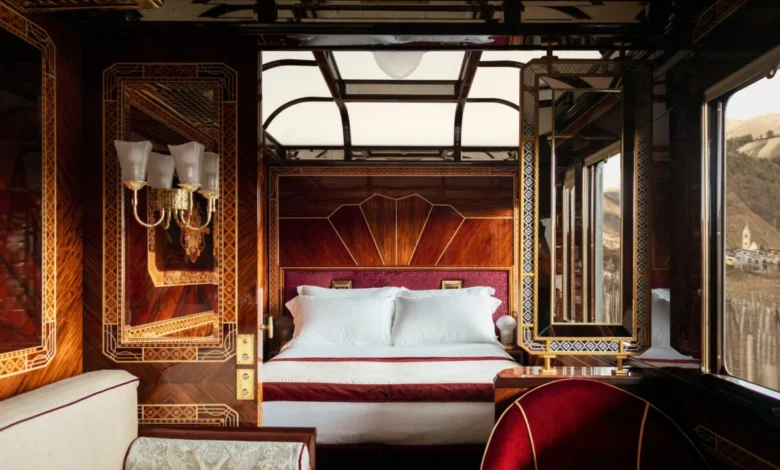
Passengers boarding the iconic midnight-blue carriages at Paris Gare de l’Est will step directly into a meticulously preserved 1920s Art Deco masterpiece. The interior craftsmanship—featuring polished marquetry, Lalique glass panels, heavy brocades, and gleaming brass fittings—reflects an era when journeys were measured not by speed, but by the quality of the experience.
The train accommodates travelers across a tiered pricing and lodging structure designed to cater to diverse preferences for privacy and historical immersion. The classic Historic Cabins serve as cozy daytime banquettes that effortlessly transform into comfortable upper and lower bunk beds by night. For guests desiring more expansive quarters, the newly introduced Suites and Grand Suites offer elevated luxury, featuring private marble en-suite bathrooms, double beds, and dedicated lounge spaces.
At the pinnacle of onboard accommodation stands L’Observatoire, an exceptionally rare private carriage designed in collaboration with the acclaimed French artist JR. Conceived as an ultra-exclusive sanctuary on the rails, L’Observatoire transcends traditional train carriage design. It features a sprawling private bedroom, a fully appointed en-suite bathroom complete with a freestanding soaking bathtub, a generous living area, an integrated library, and a hidden tearoom accessible only to the carriage’s occupants.
Gastronomy and Evening Socials
As the train cuts through the changing French landscape toward the south, evening dining becomes the central social pillar of the voyage. Culinary operations are distributed across three distinct historic carriages. Guests can choose between the intimate, exquisitely designed dining cars Étoile du Nord and L’Oriental, each showcasing original marquetry and oriental lacquerwork that survived the tumultuous geopolitical shifts of the 20th century.
The menus are executed by world-class resident chefs who source regional ingredients along the route, paired with an extensive cellar curated by master sommeliers. Following dinner, the social epicenter shifts naturally to Bar Car 3674. Here, passengers gather under the gentle flicker of antique lamps to enjoy bespoke cocktails, vintage champagne, and live piano accompaniment that echoes the legendary transatlantic crossings and interwar society gatherings of the 1920s and 1930s.

The Route: From the Capital to the Côte d’Azur
The geographic choreography of the Paris-to-Monaco itinerary has been meticulously designed to maximize scenic impact. After a restful night spent in motion, guests awaken to the gentle cadence of the rails as breakfast is served directly in their private cabins.
By mid-morning, the landscape transforms dramatically as the train transitions from the rolling countryside into the rugged terrain of the Mediterranean coast. The route guides passengers past the striking red volcanic rocks of the Massif de l’Estérel, skimming the coastline through Saint-Raphaël, and gliding past the cinematic bays of Cannes and Nice.
The final approach offers sweeping, uninterrupted vistas of the azure sea before the train pulls smoothly into the Monaco-Monte-Carlo railway station. The arrival positions guests directly within one of Europe’s most exclusive micro-states, renowned for its yacht-filled harbors, historic casino, and opulent hospitality sector.
Financial Investment and Inclusive Pricing
Operating a luxury heritage train of this magnitude requires substantial capital investment, specialized maintenance teams, and complex cross-border logistical coordination. Consequently, tickets for the inaugural Paris-to-Monte-Carlo route reflect the elite tier of the global travel market.
Fares for the overnight journey start at €4,870 (approximately $5,450 USD) per person, based on two guests sharing a Historic Cabin. To justify the substantial price point, the fare is structured as an all-inclusive luxury product. The package encompasses the overnight rail accommodation, all gourmet meals accompanied by sommelier-selected wines, unlimited soft drinks, personalized 24-hour steward service, and coordinated ground transfers upon arrival in Monaco.

This pricing model aligns with broader luxury travel trends, where affluent consumers increasingly favor frictionless, all-inclusive pricing structures that eliminate the burden of daily logistical decisions during their holidays.
Broader Industry Impact and Market Implications
The launch of the Paris-to-Monaco route is part of a broader, aggressive expansion strategy by Belmond and its parent corporation, LVMH, to solidify their dominance in the ultra-luxury experiential tourism sector. Alongside the new Monegasque itinerary, Belmond continues to scale its successful "Villeggiatura by Train" concept, which links the Venice Simplon-Orient-Express directly with historic Belmond-managed properties across Italy, creating a cohesive, multi-day slow-travel ecosystem.
Industry analysts observe that the revival of luxury sleeper trains addresses a profound psychological shift among high-net-worth travelers. As environmental scrutiny surrounding commercial aviation intensifies, and as airports become increasingly congested and impersonal, luxury rail offers a compelling value proposition: carbon-conscious mobility paired with uncompromising personal service, privacy, and architectural heritage.
By bridging the gap between historical preservation and contemporary elite hospitality, the Venice Simplon-Orient-Express does not merely transport passengers from one geographic point to another; it actively reconstructs a lost era of travel where the journey itself is the ultimate destination. As tickets for the May 2027 inaugural voyage go on demand, the rapid interest from global travelers signals that the romance of the rails remains as potent today as it was a century ago.