Virginia Lawmaker Demands Independent Audit After Deceased Family Pet Receives Official State Voting-Rights Restoration Certificate


Virginia’s ongoing debate over executive clemency and felon disenfranchisement reform took an absurd and controversial turn when a Southside Virginia lawmaker revealed that an official state-issued rights-restoration certificate had been mailed out in the name of a deceased beagle-hound mix.
Delegate Tom Garrett, a Republican representing Buckingham, is leading the charge for an immediate independent audit of Governor Abigail Spanberger’s administration following the disclosure. According to Garrett, a constituent in Goochland County received official state documentation bearing the governor’s signature, confirming that the executive branch had carefully reviewed the criminal record of a pet named Biscuit and determined that her voting and jury-service rights should be fully restored. The catch, however, is twofold: Biscuit was a canine, and she has been dead for approximately five years.
This bizarre administrative error arrives at a highly sensitive political moment. Just days before Virginia voters head to the polls to decide on an Election Day ballot measure that would enshrine automatic voting-rights restoration for former felons into the state apparatus—a push strongly backed by Richmond Democrats—the incident has ignited intense scrutiny over the administration’s vetting processes, database integrity, and basic administrative competence.

The Discovery of the Biscuit Rigsby Citation
The controversy came to light when a Goochland County resident opened official state correspondence containing a formal rights-restoration certificate addressed to their long-dead pet. Stunned by the bureaucratic blunder, the constituent forwarded the documents to Delegate Garrett, a practicing attorney in Fluvanna County and former U.S. Congressman.
The documents, which include an official seal and a signature representing the executive branch, explicitly state that the governor’s office thoroughly examined the particulars of the subject’s legal history before granting clemency.
"This is not a question of whether people who have served their sentences deserve a second chance," Garrett said in a formal statement detailing the incident. "This is a question of whether the Commonwealth is exercising one of the Governor’s constitutional powers with even the most basic level of review."
Garrett continued, driving home the absurdity of the situation: "Biscuit was a dog. Biscuit has been dead for five years. Yet an official document bearing the governor’s signature says the executive reviewed the particulars of Biscuit’s criminal case and determined her rights should be restored. Virginians deserve an explanation for how that is possible."
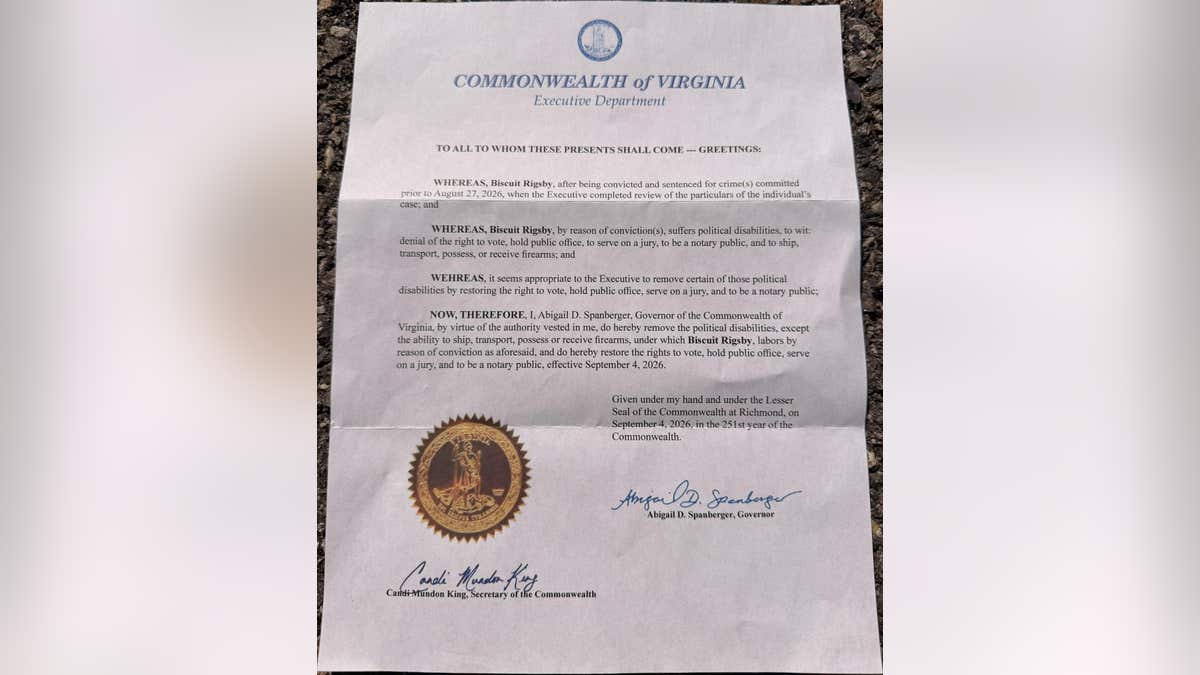
Speaking anonymously to protect against potential political backlash, the owner of the late hound confirmed the authenticity of the paperwork to media outlets. In a brief statement, the owner noted that Biscuit was "a good dog and is greatly missed," adding dryly: "To my knowledge, she was never convicted of a felony, nor did she ever show any interest in voting."
The owner further clarified that Biscuit had never been sent to an animal shelter, interacted with the penal system, or otherwise engaged in activities that could somehow mistakenly place her on state databases. Although the owner noted that a sibling is currently incarcerated, legal experts point out that this connection is irrelevant because the administration’s program is explicitly tailored toward individuals who have already been released from prison.
Mounting Administrative Flaws and the Betty No Last Name Controversy
The incident involving Biscuit the beagle is not an isolated administrative hiccup; rather, it compounds a growing pattern of troubling errors emerging from the commonwealth’s rights-restoration pipeline.
Just weeks prior, Virginia politics was rattled by the "Betty No Last Name" controversy centered in Chesapeake. In that instance, state databases processed and restored the rights of a supposed convict who possessed no surname whatsoever. Critics and watchdogs quickly pointed out that issuing legal pardons or restorations to anonymous entities or household pets highlights systemic vulnerabilities within the executive branch’s automated or semi-automated data-processing pipelines.
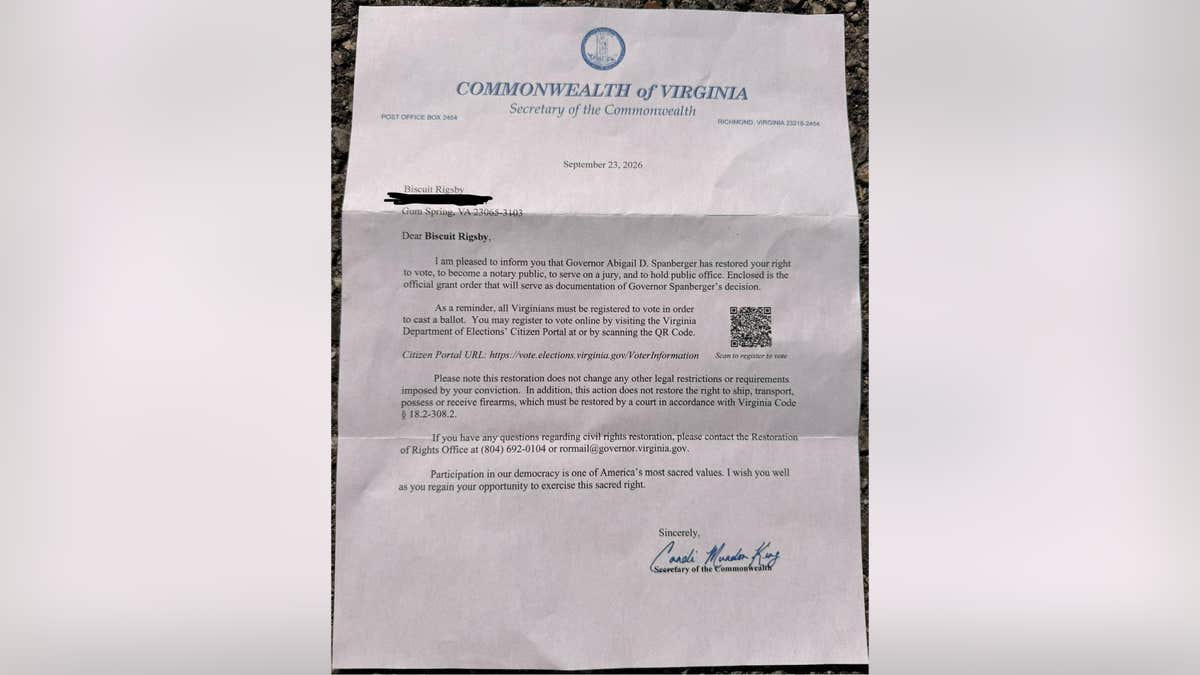
These recurring anomalies have forced lawmakers and election integrity advocates to question the accuracy of the administration’s sweeping claims regarding voter-roll updates and clemency metrics. Under Virginia’s traditional constitutional framework, the restoration of civil rights—including the right to vote, run for office, serve on a jury, and carry a firearm—has historically been handled on an individual, case-by-case basis by the sitting governor.
However, recent administrations have implemented more streamlined executive pathways to clear backlogs. The Spanberger administration accelerated this trend significantly. In July, the administration announced that Secretary of the Commonwealth Candi Mundon-King would proactively identify Virginians who had lost their civil rights, confirm their eligibility, and issue restorations en masse.
By August, the administration boasted a massive milestone, announcing that the number of restored individuals had skyrocketed from an initial baseline of 66,000 to an astonishing 100,000 people since Governor Spanberger took office in January.
While proponents of the policy champion these numbers as a triumph for civil liberties and criminal justice reform, critics argue that rushing through hundreds of thousands of files inevitably sacrifices quality control. The emergence of "Biscuit Rigsby" on the rolls suggests that quality control may have broken down entirely.

Calls for an Independent Audit and Comprehensive Transparency
In response to the growing scandal, Delegate Garrett has formally requested a sweeping, independent audit of the executive clemency apparatus. He insists that the review must go far beyond a simple apology or a quiet software patch.
Specifically, Garrett is demanding that the Spanberger administration disclose:
- The underlying electronic records and database queries that led to Biscuit being flagged as a disenfranchised felon.
- A clear definition of what the administration actually means when it claims to conduct a "review of the particulars" of each case.
- The total number of erroneous certificates, pardons, or citations issued to deceased individuals, nonexistent entities, pets, or duplicate profiles.
- Immediate directives to preserve all relevant database logs, communications, and data-matching algorithms to prevent the destruction of evidence.
"The administration told Virginians these individuals were being identified and their eligibility confirmed," Garrett stated. "The document itself represents that the executive reviewed the particulars of each case. If a deceased family pet made it through that process as a convicted felon, then we need to know what was actually reviewed, what databases were used, what safeguards existed, and how many other erroneous restorations were issued."
Garrett stressed that his demands are rooted in nonpartisan good governance, arguing that even citizens who strongly support the automatic restoration of voting rights for released felons should be deeply alarmed by the systemic failure exposed by the Biscuit case. In a video message published on social media, Garrett raised the stakes further, asking pointedly: "At what point does rank incompetence and malfeasance become criminal conduct?"

As of publication time, representatives for Governor Spanberger and Secretary of the Commonwealth Candi Mundon-King had not provided an official public response to inquiries regarding how the dog’s name made it through the vetting process.
Implications for the Upcoming Election Day Referendum
The timing of the controversy could not be more critical for Virginia’s political landscape. The incident unfolds against the backdrop of a high-stakes, statewide ballot measure scheduled for a vote on Tuesday.
Voters across the commonwealth will decide whether to amend the state’s constitution to make the restoration of voting rights entirely automatic upon an individual’s release from incarceration. The ballot initiative, championed aggressively by progressive and Democratic lawmakers in Richmond, aims to remove the discretionary power of the governor entirely, replacing it with a streamlined, administrative guarantee.
Opponents of the ballot measure argue that incidents like the "Betty No Last Name" fiasco and the "Biscuit the Dog" certificate demonstrate that Virginia’s current administrative infrastructure is fundamentally unprepared to handle voter rolls with the requisite precision. They contend that pushing through sweeping constitutional changes without first securing robust data-verification protocols risks undermining public trust in election integrity.

Conversely, supporters of automatic restoration maintain that administrative clerical errors—while embarrassing—should not be weaponized to deny civil rights to thousands of human beings who have paid their debt to society and successfully completed their sentences. They argue that a localized glitch in executive citation mailings is distinct from the actual administration of active voter registration databases managed by local general registrars and the Department of Elections.
Regardless of Tuesday’s electoral outcome, the tale of Biscuit the beagle has permanently altered the discourse surrounding civil rights restoration in the Old Dominion. What began as a quiet administrative mistake mailed to a Goochland County home has blossomed into a full-scale political flashpoint, raising serious questions about executive oversight, database hygiene, and the integrity of state records in the digital age.
Related posts: